


Provide better value for guests
People usually check hotel prices before they book, so you need to price your hotel competitively to get guests in the door – and don’t forget your bottom line! This is difficult to do manually, especially when demand varies by season, room type, or channel. Understanding average room rate meaning within your revenue strategy helps you see whether your pricing is working or quietly leaving money on the table.

Here’s how it works
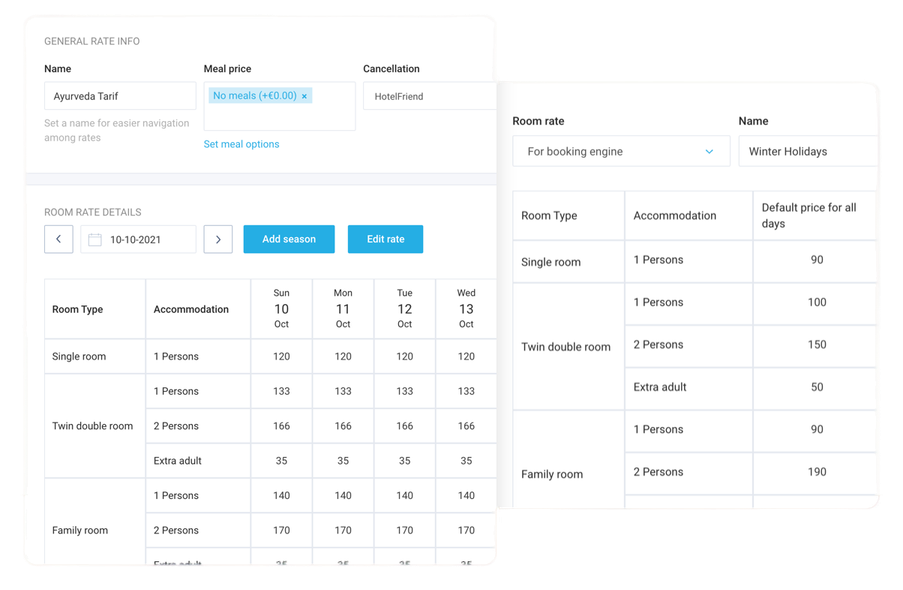
Hotel Room Rates helps hoteliers set up unlimited pricing options for different seasons. Start by naming the rate and adding meal plans. Then choose the cancellation rules and booking sources, such as your hotel website or OTAs. Finally, select the room and guest types, add a standard price, or set different rates for specific weekdays. Use the formula for the average room rate to measure how each rate plan contributes to your overall performance.
 Play Video
Adjust rates to match market shifts

Generate rates in a few steps
Set seasonal rates that remain competitive
Create unlimited rate variations
Create as many room rates as needed and tailor conditions to your strategy. Keep prices under control while giving guests flexible options, from standard rates and special offers to seasonal pricing that matches demand, occupancy, and booking behavior all year. When you regularly calculate the average room rate across your rate plans, you can clearly see which combinations are driving revenue and which need adjustment.

Control cancellation terms your way
Protect your property from losses caused by canceled bookings. Choose from free-cancellation to non-refundable rates, or create your own policies for any situation. Have clear cancellation rules in case plans change unexpectedly.
Win more seasonal guests
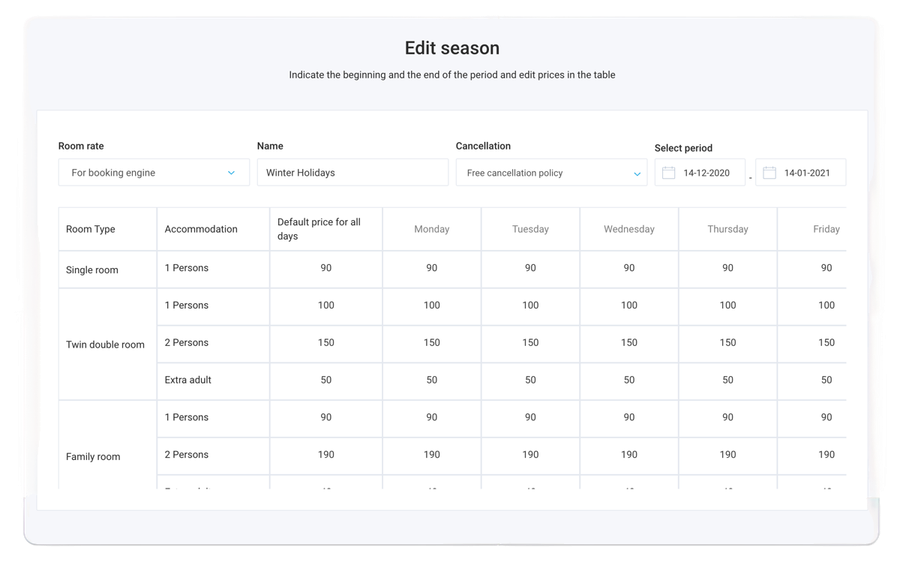
Set seasonal rate changes to run automatically for selected periods. Adjust prices for peak, high, and low seasons, then use competitive off-season rates, and keep revenue steadier year-round. Tracking your average room rate hotel performance by season shows you exactly where your pricing strategy is strongest.

Build your smartest demand strategy
Apply sales restrictions strategically. Set minimum or maximum stays, close-outs, no check-in/out rules, and more by period and room type.
Outpace your competitors
Shape your revenue strategy and grow your business potential
Sync rates and availability
Stop tracking inventory and rate accuracy manually. Set your price once, and the system will sync room rates across all booking channels automatically according to the rules you choose.


Adjust prices with virtual rates
Apply discounts or markups to any existing room rate. Charge more for one-night stays, offer lower prices for longer bookings, and strengthen your revenue management strategy. With flexible virtual rates, you can increase average stay length, improve profitability, and create more chances to sell additional services throughout the guest journey.

What you receive

Higher revenue
+ Price rooms competitively
Choose a room pricing strategy that fits your hotel, helps you stay competitive, and improves profitability.
Fast updates
+ Flexible rate control
Manage rates across every booking channel and update prices in just a few clicks whenever needed.
Smarter decisions
+ Understand guest booking behavior
Capture data in one system, review it easily, and make confident, better pricing decisions.
Clear rate visibility
+ Drive occupancy and revenue
See your active rates in minutes without refreshing 3rd-party sites or worrying about pricing accuracy.
Precise forecasting
+ Choose the right pricing strategy
Use clear reports to predict demand and reach your ADR, RevPAR, and occupancy targets.
Affordable platform
+ Access essential features for one fixed price
Access every essential tool at a fair price with no hidden fees.
«We’ve used HotelFriend products for nearly a year and are happy with the results. The Room Rates tool keeps availability and pricing up to date while making it easy to manage multiple rates at once. The interface is simple, and the support team has always answered our questions quickly.»
Hotel & Restaurant Krone
Rehau, Germany
Success Stories
HotelFriend F.A.Q.


What does average room rate meaning show in hotel revenue management?
It describes the typical income a property earns per occupied room over a set period. Revenue teams use this metric to assess pricing strength, occupancy targets, and market position, and to improve returns from available room inventory.
What data do I need to use the formula of average room rate?
You need total room revenue and the number of occupied rooms for the same date range. With accurate revenue and occupancy records, a rate management system can calculate this automatically and reduce manual errors.
Is the average room rate definition identical for every property type?
The basic idea stays the same: the average revenue per room sold. Still, the way hotels interpret the number depends on property class, market segment, and guest expectations, since budget hotels and luxury resorts work from very different pricing baselines.
How does seasonal pricing affect how hotels calculate average room rate?
Seasonal pricing blends peak, shoulder, and low-demand periods into one result when you review a full year. Clear rate differences between seasons help strong high-season revenue balance weaker months without pulling the annual figure down too much.
Can the average room rate calculation help compare my property with competitors?
Yes. Comparing your result with local comp sets or STR data shows how your pricing sits in the market. This helps reveal whether your rates are too aggressive, too low, or well aligned with similar properties.
How can HotelFriend improve average room rate property performance?
HotelFriend brings rates, room types, and booking channels into one workspace. This helps you identify weak pricing areas, compare segments more quickly, and make rate changes based on actual booking data rather than assumptions.
How should hotels use the formula for average room rate across different room categories?
Use the same basic calculation: room revenue divided by rooms sold. For better insight, also review each category separately. This shows which room types contribute most to revenue and where prices may need adjustment.
How do I find average room rate for a specific booking channel only?
You should filter your revenue and occupancy data to include only reservations from that source, then apply the standard formula. Comparing results across channels helps you understand which distribution partners deliver the most profitable bookings.
Does the average room rate meaning include complimentary stays or staff rooms?
No. Complimentary and staff-use rooms are normally removed from both revenue and room-night calculations. Adding non-revenue stays would pull the number down and distort commercial performance, so revenue managers usually track these rooms separately.
How to calculate average room rate when using promotions or discounted packages?
Use the actual revenue received after discounts, not the original rack rate. This gives you a clearer view of what rooms really earn and helps show whether promotions support revenue or weaken your pricing base.
How does HotelFriend help track the average room rate formula across rate plans?
HotelFriend keeps all rate plans in one place, so you can filter revenue and occupied-room data by date, room type, or pricing category. This removes the need to match figures manually from separate sources.
What is the difference between average room rate and RevPAR?
While average room rate measures revenue per sold room, RevPAR - Revenue Per Available Room - measures revenue per available room, including unsold inventory. Both metrics matter: a high average room rate with low occupancy can still produce a disappointing RevPAR, so a strong revenue strategy requires watching both together.
How to find average room rate trends month by month?
Calculate the rate for each month, then compare the figures in chronological order. This makes seasonal shifts, event-driven peaks, and pricing changes easier to spot, giving you a stronger basis for next year’s revenue planning.
Is the average room rate calculation the same as the average daily rate?
Yes. ARR and ADR usually describe the same hotel metric: room revenue divided by occupied rooms. The name may differ by region or system, but the purpose is the same: to show the average revenue per room sold.
How do meal plans affect the formula for average room rate?
Meal-plan income should usually be separated from room revenue. Mixing meal income into room revenue skews results and weakens comparisons with properties that track accommodation-only rates.
Can HotelFriend help me reach average room rate property targets more consistently?
Yes. HotelFriend lets you create pricing rules by room type, season, guest profile, and sales channel. Automatic rate updates keep those rules in sync across platforms, so you can maintain control of your pricing strategy with less manual effort.
How should mixed-inventory properties calculate average room rate for shared dormitory beds?
Track private rooms and dorm beds as separate categories instead of combining them. This gives a cleaner view of each product’s revenue performance and avoids distorting results across very different accommodation types.
How often should hotels review their average room rate definition for reporting?
The core metric stays the same, but your internal reporting rules should be checked at least once a year. Clear, consistent rules around included revenue streams make annual comparisons more reliable and easier to explain.
What about last-minute discounting in the formula of average room rate?
They often discount late, so the final selling price for occupied rooms is lower. Even if occupancy stays the same, the calculated rate drops. If you compare these patterns over time, you can see whether the extra bookings are worth the weaker room-rate performance.
How do HotelFriend’s virtual rates affect average room rate meaning in reports?
HotelFriend’s virtual rate feature adjusts the base price with discounts or markups to ensure each booking is recorded at its final selling price. In this way, your reports can show the real revenue generated by each room type or segment.
What benchmark should I use when I calculate average room rate for my market segment?
The best benchmark is STR reports or a local competitive set of like properties. Having internal results is great, but you need to compare externally to see if your pricing is really strong for your segment.
How do cancellations affect ARR calculation?
Canceled bookings are usually excluded because the metric is based on completed stays and earned room revenue. If cancellations are frequent, compare results before and after cancellations to see how much lost demand affects your overall revenue picture.
How should hotels calculate average room rate for OTA bookings with net rates?
If you are paid at net rates for OTA bookings, your outcome depends on the revenue basis you choose, i.e., gross listed revenue or the amount actually received. Net is usually preferred by revenue teams because it’s real income. This rule is set up front to keep channel comparisons clear.
How can HotelFriend compare average room rate hotel performance across booking sources?
With every booking source visible in one place, you can quickly see where your strongest revenue is coming from - whether that is your front desk, an OTA, a corporate contract, or a group deal - and decide where your distribution effort is best spent.
How does the average room rate formula connect to pricing strategy?
It makes pricing choices a straightforward signal of performance. If rate changes, discounts, or seasonal adjustments take the result in the right direction, your strategy is working to help achieve revenue goals. If not, you may want to reconsider your pricing strategy.
How to find average room rate differences between weekdays and weekends?
Separate weekday and weekend bookings before running the calculation. Compare room revenue and sold nights for each group, then review the results side by side. If the gap is clear, it may support different rate rules for weekdays and weekends.
Should taxes be included in the average room rate definition?
It depends on how you report it. Hotels may use pre-tax or post-tax revenue, but industry benchmarks are typically pre-tax. Make sure to check how your comp set and reporting tools handle taxes to make apples-to-apples comparisons.
How does HotelFriend’s rate syncing keep average room rate meaning stable over time?
HotelFriend automatically updates prices across connected channels, so the same room is not sold at conflicting rates on different platforms. Cleaner rate control helps prevent scattered revenue figures and makes long-term reporting easier to compare.
How does a long-stay promotion affect the formula of average room rate?
Long-stay packages save more the longer you stay. That can hurt your per-night performance, but it can also increase booking value, lower guest turnover, and help you achieve more consistent occupancy, depending on which metric you care most about.
How can minimum stay rules influence ARR calculation?
Minimum stay rules can prevent short, low-value bookings during busy periods and encourage longer stays, leading to higher total revenue. When used properly, they help avoid one-night gaps and achieve higher yields during periods of high demand.
How to calculate average room rate with dynamic pricing?
When prices shift with demand, add the room revenue from all sold nights during the chosen period, then divide by the number of occupied rooms. The calculation stays the same, but the result reflects a broader mix of price points than fixed-rate pricing.
How does HotelFriend support the formula of average room rate when prices change often?
HotelFriend stores each reservation with the confirmed booking price, even if rates change later. This keeps your reporting data accurate and helps you see how daily pricing decisions affect real revenue.
What is the average room rate meaning for group bookings versus transient stays?
For group reservations, hotels often work with pre-agreed contract prices that sit below standard individual rates. Separating group and transient revenue helps you see whether higher booking volume offsets the lower price.
How can the average room rate hotel metric strengthen my direct booking strategy?
Compare direct reservations vs. OTA bookings to see if your channel is commanding a higher rate. If your direct stays are outperforming third-party sources, it’s a sign that your incentives, guest relationships, and booking experience are driving better pricing.
How should hotels apply the formula for average room rate to inclusive packages?
For bundled offers, separate the accommodation portion from extras like spa access, meals, or activity credits. Reporting only the room value keeps the metric focused on lodging performance instead of mixing it with add-on revenue.
How can HotelFriend support average room rate calculation in forecasting?
HotelFriend combines rate, occupancy, and booking data into a single system, providing hotels with reliable historical data for future planning. Its forecasting reports help teams set realistic ADR goals and adjust prices around expected demand before the booking window starts.
How to find average room rate for one room type over a full season?
Filter your data by the selected room category and season, then divide its total room revenue by the number of sold nights. Running this check for each category shows which room types drive the strongest seasonal performance.
What external factors can change the average room rate meaning in urban hotels?
City hotels are often affected by major events, business travel patterns, and changes in nearby room supply. Tracking these signals alongside your pricing data helps you spot changes in demand earlier and adjust rates before occupancy shifts.
How do early booking discounts affect the formula of average room rate?
Early-booking offers reduce revenue per room night for reservations made in advance. Once guests complete those stays, reports show the discounted value, so hotels need to balance advance demand with stronger pricing closer to arrival.
How does HotelFriend help new hotels calculate average room rate from the start?
HotelFriend lets new properties build rate plans before their first bookings arrive. As reservations are confirmed, the system stores the revenue and occupancy data needed for early reporting, providing hotels with a benchmark for future pricing decisions.
How do I handle pricing for guests who book directly through my hotel website versus through an OTA?
You can create separate rate plans for each booking source and assign them to the relevant channel. This gives you full control over direct versus third-party pricing, allowing you to offer better value on your own website without violating parity agreements or disrupting your OTA relationships.
Is it possible to restrict certain rate plans so that only specific guest types can access them?
Yes. Rate plans can be configured by guest type, so corporate rates, group rates, and loyalty pricing can each be made available only to their intended audiences. This keeps your public rates clean and ensures that negotiated pricing reaches the right guests without being visible to everyone.
How does HotelFriend handle rate updates when I need to make urgent pricing changes during peak demand?
HotelFriend lets you update rates across all connected channels in just a few clicks, so urgent changes during high-demand periods can be made and distributed quickly. There is no need to log in to each channel separately - a single update in the system propagates to all sources according to your distribution settings.
Can I preview how my rates will appear to guests before making them live?
Before activating a rate plan, you can review all the conditions within the system to confirm everything looks correct. This reduces the chance of errors reaching guests and gives you confidence that your pricing is set up exactly as intended.
Can I set different prices for the same room depending on how far in advance a guest books?
Yes. Advance purchase rates let you reward early bookers with a lower price while protecting higher rates for last-minute reservations. This approach helps fill your calendar earlier in the booking window and provides a more stable foundation for your revenue forecast.
What is the impact on my rates if I change a base rate plan?
When you update a base rate, any virtual rates based on it will automatically reflect the change according to the discount or markup rules you have set. As all dependent rate plans adjust according to the base rate, your pricing will be consistent across all channels without you having to do anything else.
What are the tell-tale signs that my room rates are not responding to real market demand?
Empty rooms with no revenue growth are a powerful warning sign. When occupancy is strong but RevPAR is flat, the gap typically indicates pricing that lags the curve of what guests are actually willing to pay. To gauge whether demand is strong enough to merit a rate increase, look at how far in advance rooms are selling and compare that to your current rate levels.
Do cancellation conditions have to be the same across all my rate plans?
Not at all. Stricter terms for discounted rates and looser conditions for premium ones can coexist for the same room. Guests gravitate toward whichever option best suits their booking confidence, and your revenue protection remains intact on the rates that matter most.
How should a new hotel set its first room rates?
Look at similar properties in the area to see what guests are already paying. When real booking patterns occur, use them. Then change or fine-tune rates based on demand, not a guess.
How does overbooking strategy interact with room rate performance?
Controlled overbooking is designed to protect occupancy against anticipated cancellations and, as such, supports stable room-rate results. But overbooking can result in walk-ins for whom the cost of relocating them eats up the revenue gain, so the strategy works best when cancellation forecasters base their predictions on reliable historical patterns rather than guesswork.
Should I lower rates during a slow period or invest in marketing instead?
Discounting in the slow periods can spur reservations, but it sets a price expectation that is hard to reverse. The incremental approach typically does a better job of protecting your long-term rate integrity versus broad discounting across channels.
How do length-of-stay discounts affect total revenue compared to flat nightly rates?
Length-of-stay discounts reduce the per-night price, raise the total reservation value, reduce cleaning and turnover costs, and increase occupancy continuity. With proper modeling, longer stays at a moderate discount can trump a series of shorter stays at full rate, especially during shoulder seasons when filling gaps is a constant challenge.
Can HotelFriend help me manage rates for multiple properties from a single account?
HotelFriend is designed for multi-property management - you can manage rate plans, room types, and channel settings for different properties from one workspace. That reduces administrative overhead when moving between systems and makes it easier to maintain consistent pricing logic across your portfolio, while keeping each property’s settings independent.
What is the impact of guest reviews on room rate performance over time?
Strong review scores give properties greater pricing confidence because guests are demonstrably willing to pay more for a stay at a property with a proven record of quality. Hotels with consistently high ratings can typically sustain rates above their competitive set without a significant drop in conversion, making reputation management a direct contributor to long-term revenue performance.

HotelFriend Features
Hotel Management
Finance & Payment
Revenue Management
Guest Relations
Digital Marketing