
Choosing a property management system is rarely a one-and-done decision. It's a relationship that either grows with a hotel or starts holding it back. For many independent properties, RoomRaccoon alternatives have become a regular search term as owners run into commission fees, DACH compliance gaps, or a feature set that no longer matches how their business operates.
This guide breaks down the eight strongest RoomRaccoon competitors on the market in 2026. And then shows you how to choose the best PMS for independent hotels for your property, budget, and growth plans.
Why Hotels Look for RoomRaccoon Alternatives
RoomRaccoon is well-regarded as a comprehensive property management system for independent hotels and small hospitality groups, but it’s not suitable for every property. As properties grow, diversify their operations, or expand into new markets, certain limitations tend to surface. Here's a closer look at the most common reasons hotels start exploring other options.
Pricing and Transaction Costs
Cost is one of the biggest drivers of switching. Aside from the basic subscription, RoomRaccoon normally also takes a commission on the bookings processed through its payment system. This can slowly erode margins for hotels with high booking volumes or a lot of direct-booking traffic that otherwise might be protected by a more transparent pricing model.
Key concerns hotels raise include:
- ● Commission fees on top of subscription costs: bookings processed through RoomRaccoon's payment system often carry additional fees beyond the base plan.
- ● Costs that scale with success: high booking volumes or strong direct-booking traffic mean transaction fees add up faster, working against growth instead of rewarding it.
- ● Margin erosion: these combined costs can eat into profitability in ways that aren't always obvious.
- ● Demand for predictability: properties evaluating alternatives typically want flat-fee or more transparent pricing that scales sensibly with revenue.
Affordable PMS Case:
Picture a 14-room seaside guesthouse, filling up with direct bookings. The RoomRaccoon subscription seems cheap, but the commission fees on the large volume of direct payments add up over a season, and the effective monthly cost is almost twice the sticker price. Switching to a flat-fee affordable hotel PMS like Sirvoy or Little Hotelier restores predictability, since owners can forecast software costs the same way they forecast staffing costs.
Feature Flexibility
While RoomRaccoon covers the basics such as bookings, channel management, and basic CRM, some hotels find the platform’s feature set to be a little too rigid for their specific workflows. Properties with specific operational requirements such as complex rate structures, group bookings, event space management, or advanced upselling tools may find themselves working around the system, rather than with it. Hotels that need deeper customization or more robust third-party integrations often look for an alternative to RoomRaccoon that adapts to their business rather than forcing them to adapt to it.
Accounting and DACH Compliance
For hotels operating in the DACH region (Germany, Austria, Switzerland), local compliance rules are a must. This includes compliant record-keeping according to GoBD, correct handling of VAT, and integration with regional accounting standards and software. However, some hotels find that the accounting features available in RoomRaccoon don’t completely meet these regional requirements. This can lead to additional administrative effort and a higher risk of compliance errors.
Key concerns hotels raise include:
- ● GoBD compliance gaps: RoomRaccoon's record-keeping may not fully satisfy Germany's strict GoBD requirements for audit-proof, unchangeable financial data.
- ● VAT handling limitations: applying and reporting VAT across DACH tax rules can require manual adjustments rather than native handling.
- ● Limited integration with regional accounting software: hotels often have to integrate with local accounting platforms and standards, and gaps here mean more manual work or separate tools.
- ● Increased administrative burden: workarounds and manual processes add time and complexity for finance teams.
- ● Higher compliance risk: the more manual the process, the greater the chance of errors that could create issues during audits or tax filings.
This is a strong motivator for DACH-based hotels to seek a PMS built with regional compliance requirements in mind from the start.
Support and Onboarding
Responsive, knowledgeable support is hugely important in hospitality where a system outage or configuration issue can have a direct impact on guest experience and revenue. RoomRaccoon’s support response times or onboarding depth aren’t a fit for some hotels’ pace of operations, especially during peak season or when troubleshooting urgent issues. Hotels that value hands-on onboarding, faster response times, or a dedicated account manager often cite support quality as a deciding factor when evaluating alternatives.
Scaling Beyond One Property
RoomRaccoon is great for independent, single-property hotels, but multi-property groups and growing hotel chains often run into friction as they scale. The platform isn’t built to offer the more sophisticated multi-property tools needed to manage rates, inventory, and reporting from one dashboard across multiple locations. Hotels looking to expand or that already operate multiple properties often seek a PMS designed from the ground up for portfolio-level management, centralized reporting, and consistent operations across locations.
How We Evaluated RoomRaccoon Competitors
To make this comparison really useful, we evaluated each RoomRaccoon alternative against a consistent set of criteria that reflect what hotels actually care about day-to-day. Here’s a summary of the areas we focused on and why they matter.
Ease of Use
A PMS is only as good as a team’s ability to use it effectively. We considered the ease of learning the platform interface for front desk staff, managers, and housekeeping teams, as well as the learning curve for new hires and the amount of training needed to get a property fully up and running. We rated platforms that require a lot of onboarding or ongoing support to do basic things lower than platforms with clean, logical workflows.
Core PMS Features
We wanted to see beyond the basics of reservations and room management to see how well each platform handled the realities of running a hotel. We were particularly interested in whether the platforms could support more complex scenarios, like group bookings or event spaces, without workarounds.
Areas we evaluated include:
- ● Rate and inventory management: how simple it is to set up, change, and maintain rates, availability, and room inventory for various scenarios.
- ● Housekeeping coordination: tools for managing room status, cleaning schedules, and communication between front desk and housekeeping staff.
- ● Guest communication tools: built-in messaging, automated notifications, and pre- or post-stay communication capabilities.
- ● Reporting depth: the range and detail of reports available for tracking performance, occupancy, and revenue.
- ● Flexibility for different property structures: support for different room types, rate plans, and configurations without forcing hotels into a fixed setup.
- ● Handling of complex scenarios: how well each platform manages group bookings, event spaces, and other non-standard use cases without requiring manual workarounds.
Booking Engine and Channel Manager
Hotel revenue is generated from direct bookings and distribution to OTAs, so we tested how robust and reliable each platform’s booking engine and channel manager were. The key issues were the number of OTA integrations supported, how well rates and availability were synced across channels in real-time, how conversion-friendly the direct booking engine was, and how much control hotels had over rate parity and channel-specific pricing strategies.
Payments and Accounting
We took a close look at how each platform handles payments, from the types of payments accepted to the fee structure and whether hotels are tied to a specific payment provider. We looked at accounting, integration with popular accounting software, VAT and tax processing, and, in particular for hotels in the DACH region, compliance with local requirements such as GoBD record-keeping standards.
Pricing and Scalability
We examined the full cost structure for each platform, including base subscription fees, transaction or commission costs, and any hidden or add-on charges that can affect total cost of ownership. We also considered the scalability of each solution, whether it’s built for single-property, independent hotels or built to support multi-property groups that require centralized management, consistent reporting, and portfolio-level oversight as a business grows.
RoomRaccoon Alternatives at a Glance
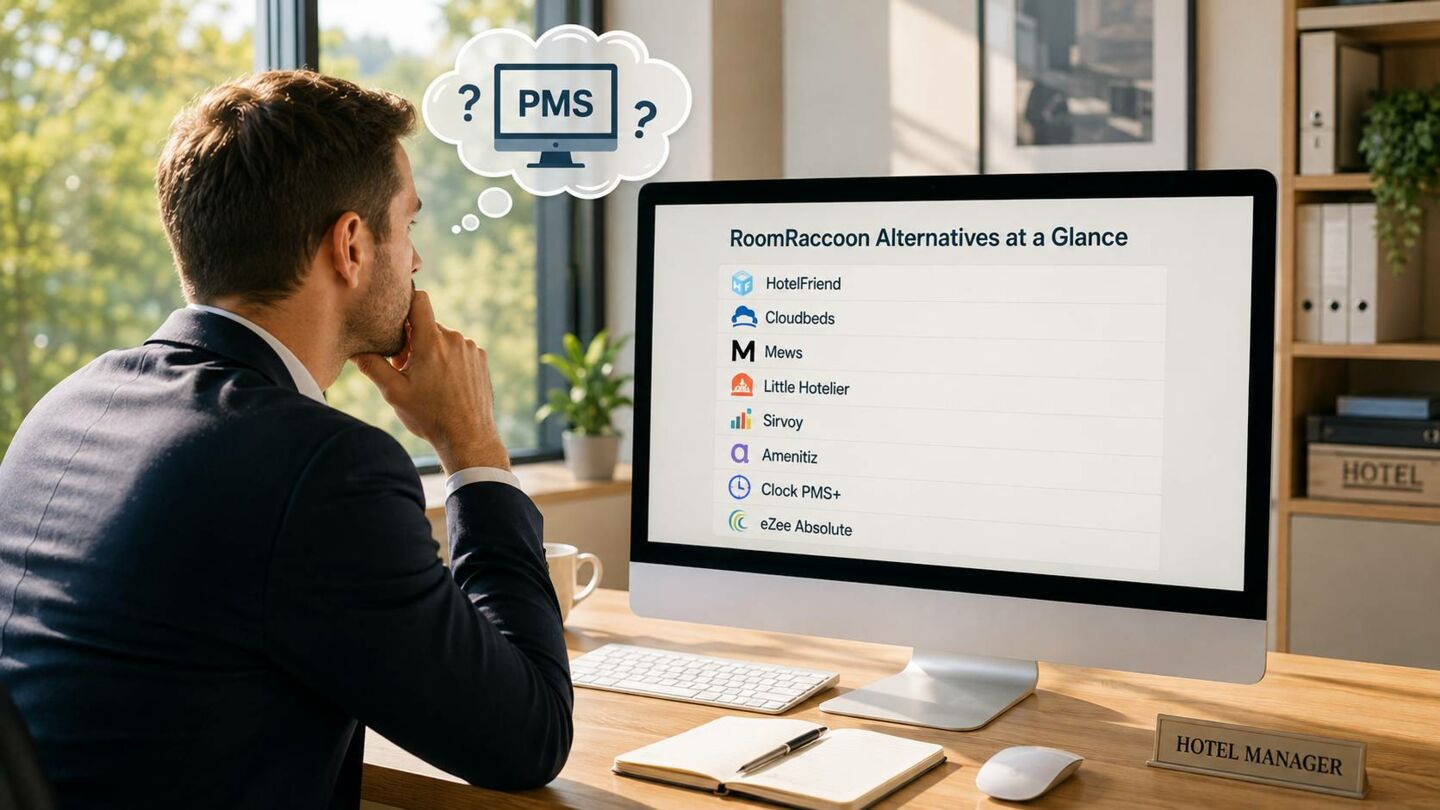
Pricing is rarely as simple as the number on the vendor’s homepage. Most PMS providers offer tiered plans, per-room fees, or custom quotes that vary based on property size and add-ons. Here’s a breakdown of what each RoomRaccoon alternative offers, how much they cost, and the best use case for each so you can quickly see which platforms are worth a closer look.
The 8 Best RoomRaccoon Alternatives in 2026
|
PMS |
Key Features |
Starting Price |
Best Fit For |
|
HotelFriend |
Booking Engine, Channel Manager, guest app, DACH compliance tools, multi-property dashboard, housekeeping management |
From around €30 to €80/month, scaling with modules and rooms |
Hotels in the DACH region needing strong compliance support and multi-property scalability |
|
Cloudbeds |
Channel manager and booking engine, revenue management, large integration marketplace, guest messaging and CRM, advanced reporting |
From around $180 to $200/month |
Independent hotels and small groups wanting an all-in-one platform with a large integration marketplace |
|
Mews |
Cloud-native automation, open API, guest self-service tools, multi-currency support, app marketplace |
From around €300/month, quote-based |
Mid-size to larger properties and groups wanting a highly flexible, tech-forward system |
|
Little Hotelier |
Channel manager and booking engine, easy setup, basic reporting, mobile dashboard, minimal training needed |
From around €29/month, scaling with room count |
Small independent hotels, B&Bs, and guesthouses wanting an easy, low-cost solution |
|
Sirvoy |
Booking engine and channel manager, point-of-sale tools, simple rate management, basic guest communication, quick setup |
From around $15/month |
Small properties and hostels prioritizing simplicity and budget-friendly pricing |
|
Amenitiz |
Booking engine and channel manager, built-in payments, website builder, guest upselling tools, bundled onboarding |
From around €42 to €89/month, depending on tier |
Small to mid-size independent hotels wanting a simple, bundled solution |
|
Clock PMS+ |
Customizable rate configuration, group and event booking tools, multi-property support, open API, flexible packages |
From around $150/property/month |
Hotels and resorts needing flexible configuration for groups, events, and complex rate structures |
|
eZee Absolute |
Multi-property dashboard, strong reporting, channel manager and booking engine, wide integrations, POS and housekeeping |
From around $45 to $50/month, tiered by feature bundle |
Growing hotel groups and multi-property operators needing centralized management and detailed reporting |
(Information is taken from open sources. Valid as of August 2026)
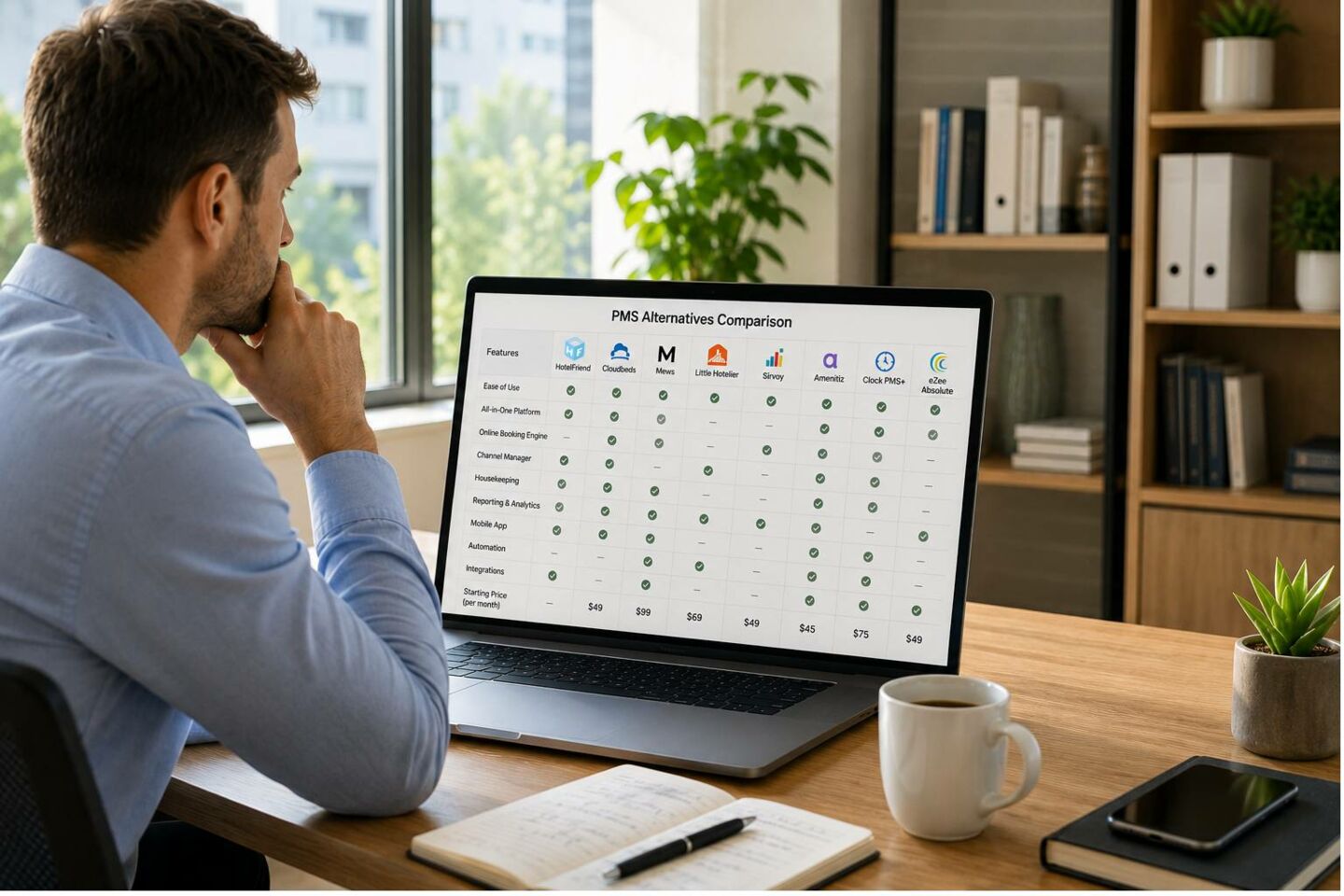
Not all hotels should use the same platform. Budget independent properties may not be able to compete with the price of Sirvoy or Little Hotelier, while hotels looking for advanced compliance support or multi-property scalability may consider HotelFriend or Cloudbeds. Larger groups with complex operations might find Mews or Clock PMS+ better suited to their needs. Whatever the priority, it's worth requesting a live demo and a detailed quote before committing, since advertised starting prices rarely reflect the full cost once room count, modules, and transaction fees are factored in.
RoomRaccoon vs HotelFriend: A Quick Comparison
Of all the platforms compared here, RoomRaccoon vs HotelFriend is one of the most common head-to-head searches because HotelFriend targets a very similar audience but leans harder into DACH compliance and multi-property scalability.
RoomRaccoon vs HotelFriend Table
| - |
RoomRaccoon |
HotelFriend |
|
Pricing model |
Subscription + commission on payments |
Tiered, module-based (€30–€80/month) |
|
DACH compliance |
Limited native support |
GoBD, TSE, and DATEV export support |
|
Multi-property tools |
Limited |
Multi-property dashboard included |
|
Best for |
Single-property, straightforward operations |
Independent hotels needing compliance and room to scale |
RoomRaccoon Alternatives: Pricing Comparison
Subscription price is only part of the picture. Transaction fees, payment processing cuts, and gated add-ons can push the real cost of a PMS well beyond its advertised starting price. The table below lays out what each RoomRaccoon alternative charges across these three cost layers, making it easier to spot where the hidden expenses tend to hide.
Subscription, Transaction, and Add-On Costs
|
PMS |
Base Subscription |
Transaction Fees |
Notable Add-On Costs |
|
HotelFriend |
From around €30 to €80/month, scaling with modules |
Varies by payment setup |
Custom development, white-label apps, and advanced modules billed separately |
|
Cloudbeds |
From around $180 to $200/month |
Per-transaction fees on bundled Cloudbeds Payments |
Implementation and customization costs can range from $500 to $5,000+ |
|
Mews |
From around €300/month, quote-based |
Per-transaction and per-card tokenization fees reported |
Revenue management and guest messaging modules add to base cost |
|
Little Hotelier |
From around €29/month, scaling with room count |
Entry-tier plan adds around 1% per booking value |
Higher tiers needed for advanced booking engine features |
|
Sirvoy |
From around $15/month |
No percentage-of-sales fee reported |
Point-of-sale and website builder available as add-ons |
|
Amenitiz |
From around €42 to €89/month, depending on tier |
Payment processing via bundled AmenitizPay |
Channel manager and dynamic pricing gated behind higher tiers |
|
Clock PMS+ |
From around $150/property/month |
Varies by payment integration |
Group and event management tools may require higher-tier plans |
|
eZee Absolute |
From around $45 to $50/month, tiered by bundle |
Varies by payment setup |
Channel manager and booking engine require moving up plan tiers |
(Information is taken from open sources. Valid as of August 2026)
Best Alternatives by Property Type
Not every hotel needs the same PMS. What works for a 200-room group won't suit a five-room B&B, and the right fit depends on your property type, team size, budget, and how much flexibility or compliance support you need. Here's a quick breakdown of which RoomRaccoon alternatives make the most sense for different kinds of accommodations, from independent hotels to boutique properties to multi-location groups.
Small Independent Hotels
For small independent hotels, budget and simplicity tend to matter most, making low-cost, easy-to-set-up platforms the best fit.
- ● Sirvoy stands out for its low starting price and lack of a percentage-of-sales fee.
- ● Little Hotelier is a strong option for owner-operators who want an affordable, all-in-one system without a steep learning curve.
Both solutions focus on fast onboarding rather than deep customization, which is better for lean property teams.

Illustrative case - Independent hotels:
Consider a 20-room family-run hotel that has relied on manual spreadsheets alongside RoomRaccoon for rate planning because the platform's rate tools felt too rigid for its seasonal pricing strategy. After trialing a more flexible alternative to RoomRaccoon like Little Hotelier, the owner consolidates rate planning, channel distribution, and reporting into one dashboard. It cuts the weekly admin time spent reconciling spreadsheets.
Boutique Hotels
Boutique properties often need more flexibility in guest experience and branding than budget platforms offer.
- ● Mews is a strong fit thanks to its open API, guest self-service tools, and app marketplace for tailoring the platform.
- ● Cloudbeds works well for boutique properties wanting a bundled channel manager, booking engine, and CRM in one system.
Both platforms support more sophisticated guest communication and upselling than entry-level PMS options.
Bed and Breakfast Properties
- Simplicity, affordability, and ease of use are the priority, since most B&Bs run with minimal staff.
- ● Little Hotelier is purpose-built for small properties like B&Bs, guesthouses, and inns.
- ● Sirvoy also fits well, with the added flexibility to relabel terminology (for example, "Room" to "Cabin") for non-standard accommodation types.
Neither platform requires extensive technical setup, which matters for owner-operated properties.
Growing Hotel Groups
Multi-property management, centralized reporting, and scalability become essential as portfolios expand.
- ● HotelFriend supports multi-property operations with centralized reporting suited to expanding groups.
- ● eZee Absolute offers a multi-property dashboard and wide integration support suited to expanding groups.
- ● Clock PMS+ provides flexible configuration for groups managing complex rate structures or event spaces across properties.
- ● Cloudbeds can also scale into this category with its revenue management tools and integration marketplace.
DACH-Based Hotels
Compliance with GoBD, VAT, and regional accounting standards is non-negotiable in Germany, Austria, and Switzerland.
- ● HotelFriend is built with DACH compliance in mind, including GoBD, TSE, and DATEV export support.
Hotels in this region should confirm that any alternative offers native compliance tools rather than requiring manual workarounds or separate accounting software. This makes compliance readiness one of the most important filters when shortlisting a platform for DACH-based operations.
RoomRaccoon Migration Checklist
Switching PMS platforms is a significant operational shift, so a structured approach helps avoid data loss, booking gaps, or guest-facing disruptions during the transition.
Before Migration
- ● Export all historical data from RoomRaccoon, including reservations, guest profiles, rate plans, and financial records.
- ● Document current workflows, room types, rate structures, and any custom configurations in use.
- ● Review OTA and channel manager connections to understand what needs to be reconnected on the new platform.
- ● Check contract terms with RoomRaccoon for cancellation notice periods and any early termination fees.
- ● Confirm data compatibility and migration support with the new provider before committing.
Choosing a Migration Date
- ● Schedule the switch during a lower-occupancy period to minimize guest impact.
- ● Avoid migrating during active group bookings, events, or peak booking windows.
- ● Build in buffer time before and after the migration for testing and troubleshooting.
During Migration
- ● Set up the new PMS in parallel with RoomRaccoon rather than switching overnight.
- ● Migrate historical guest and reservation data first, then validate accuracy before going live.
- ● Reconnect channel manager integrations and confirm rates and availability sync correctly across OTAs.
- ● Test the booking engine end-to-end, including payment processing, confirmation emails, and cancellation flows.
- ● Recreate rate plans, packages, and promotions exactly as they existed in RoomRaccoon.
Staff Preparation
- ● Train front desk, housekeeping, and management teams on the new system before go-live.
- ● Assign a point of contact for troubleshooting during the transition period.
- ● Prepare quick-reference guides for common daily tasks to reduce disruption.
After Migration
- ● Monitor bookings, payments, and channel sync closely for the first one to two weeks.
- ● Reconcile financial records between the old and new systems to confirm nothing was lost.
- ● Deactivate RoomRaccoon only after confirming the new platform is fully operational and stable.
- ● Collect staff feedback to identify any remaining gaps or training needs.
Illustrative case - Migration intent:
Take a 35-room hotel that has decided to leave RoomRaccoon after outgrowing its multi-property tools. Rather than switching overnight, the operations manager runs the new PMS in parallel for two weeks, migrates historical guest data first, and validates every rate plan before go-live. The result is a transition with no double-bookings and no gap in OTA visibility. The outcome the checklist above is designed to produce.
Final Verdict
RoomRaccoon works well for straightforward, single-property operations, but hotels that need tighter cost control, deeper compliance support, or room to scale often find its pricing structure and feature set limiting over time. Among the RoomRaccoon alternatives compared here, HotelFriend stands out as a particularly strong option for hotels of all sizes, including those in the DACH region needing strong compliance support, thanks to its all-in-one PMS, booking engine, GoBD- and DATEV-ready accounting tools, and a platform that scales from a single property to a multi-property operation.
For hotels prioritizing pure affordability and simplicity, Sirvoy and Little Hotelier remain hard to beat, while Cloudbeds and Mews suit properties wanting a more feature-rich, flexible system. Ultimately, the right choice depends on matching a platform's pricing model, compliance capabilities, and scalability to your property's specific stage of growth, so requesting a detailed quote and testing migration support before committing is always worth the extra step.


HotelFriend F.A.Q.
Frequently Asked Questions
What Is the Best RoomRaccoon Alternative?
HotelFriend stands out as a strong RoomRaccoon alternative for hotels that need more than basic booking and channel management. It combines an all-in-one PMS with a booking engine, channel manager, guest app, and built-in DACH compliance tools, making it a solid fit for hotels wanting a comprehensive platform rather than piecing together separate tools.
Which Alternative Is Best for Small Hotels?
HotelFriend offers tiered, room-based pricing that scales with property size, which allows small hotels to start with core PMS and booking engine functionality without paying for enterprise-level features they don't need. As the property grows, additional modules like the channel manager and multi-property dashboard can be added.
Which Provider Offers the Most Transparent Pricing?
HotelFriend uses a tiered pricing model based on room count and selected modules, with published starting prices for its PMS and booking engine packages. Since costs scale with the specific features and property size, it's worth requesting a tailored quote to see the exact breakdown for your property rather than relying on the advertised starting price alone.
Can RoomRaccoon Reservations Be Migrated?
Yes, reservation data, guest profiles, and rate plans can generally be exported from RoomRaccoon and migrated to HotelFriend, though the exact process depends on data compatibility and the migration support HotelFriend provides. It's best to confirm migration assistance directly with HotelFriend in advance, export all historical data before switching, and validate accuracy before fully transitioning away from RoomRaccoon.