
Effective digitalization starts with a hotel workflow, not a software catalogue. The aim is to make accurate information available where staff and guests need it. That can mean keeping rates aligned across sales channels, giving housekeeping a reliable room list, or tracing a payment from reservation to accounting.
The right plan depends on the property. An independent city hotel, a spa resort, and a small group have different services, teams, and controls. Each should decide which problems to solve first, which data must move between systems, and who owns the result.
Turn strategy into a short list of operational priorities
Begin by mapping a normal hotel day. Follow a reservation from creation through arrival, stay, checkout, payment, and reporting. Include changes, cancellations, room moves, failed payments, maintenance faults, and guest requests. These exceptions often reveal more than a standard product demonstration.
List the delays, duplicate entries, unclear ownership, and manual checks in each process. Then rank them by guest impact, financial risk, staff effort, and implementation difficulty. A hotel may learn that reliable distribution data matters more than a new guest app. Another may find that room status or invoice exports cause the greatest disruption.
Set a narrow outcome for the first project. Define the current baseline, the desired process, the owner, and the evidence needed for acceptance. Avoid a target such as “become fully digital.” It gives neither staff nor suppliers a testable result.
Use the PMS as an operational core
A property management system usually holds reservations, room inventory, stay dates, guest and company records, room status, and folio information. Product scope varies, so hotels should identify which records the PMS controls and which belong in accounting, payments, point of sale, CRM, or another specialist system.

Test a realistic configuration. Create, change, cancel, and restore a reservation. Move rooms, split charges, process deposits and refunds, correct a posting, and handle a no-show. If the hotel accepts group or corporate bookings, include their rates, billing instructions, and rooming-list changes.
A cloud PMS can reduce the need to operate a local server, but the word “cloud” does not prove performance or resilience. Ask about service commitments, maintenance, authentication, roles, logs, backups, recovery objectives, and offline procedures. Confirm how the hotel can retrieve data when a contract ends.
Connect the website to live booking operations

A booking engine should display current availability and guide a traveler from dates to confirmation. Check the entire route on common phone and desktop sizes. The selected room, occupancy, rate, taxes, fees, cancellation terms, and payment conditions should remain clear.
Test unavailable dates, validation errors, payment failure, abandoned sessions, and return visits. Confirm how reservations enter the PMS and how inventory changes return to the booking engine. Campaign landing pages should lead to the advertised room or offer rather than a generic search page.
Direct booking does not mean cost-free booking. A hotel may avoid an OTA commission on a direct reservation, yet still pay for its website, booking technology, payment processing, advertising, metasearch, content, and staff. Compare channels with consistent cost definitions and the value of the demand they bring.
Manage rates and availability across distribution channels
A channel manager exchanges availability, rates, restrictions, and reservations with connected sales channels. It can reduce repeated manual updates when room mappings and interfaces work as intended. It cannot repair unclear rate rules or incorrect source data.
Before launch, align room types, occupancy, rate plans, taxes, restrictions, and cancellation policies. Import existing reservations and plan the cutover. Then test new bookings, changes, cancellations, closures, minimum stays, and failed messages.
Ask who operates each connector and what monitoring is visible to hotel staff. Define the support route when the PMS and sales channel disagree. AHLA/HTNG identifies inconsistent integration patterns as a current industry challenge, so interface governance should be part of procurement.
Offer digital arrival without removing guest choice
Online registration, mobile check-in, kiosks, digital payments, and digital keys can change the arrival process. A property should choose the steps that fit its building, staffing, guests, and legal duties. Self-service should be an option where it helps, not a barrier for guests who need assistance.
Test identity checks, registration data, signatures, room assignment, payment, key delivery, early arrival, accessibility, and exception support. Define what happens when a device, payment, lock, or reservation lookup fails. Staff must know when to intervene and how to complete the process safely.
Give housekeeping and maintenance dependable status data
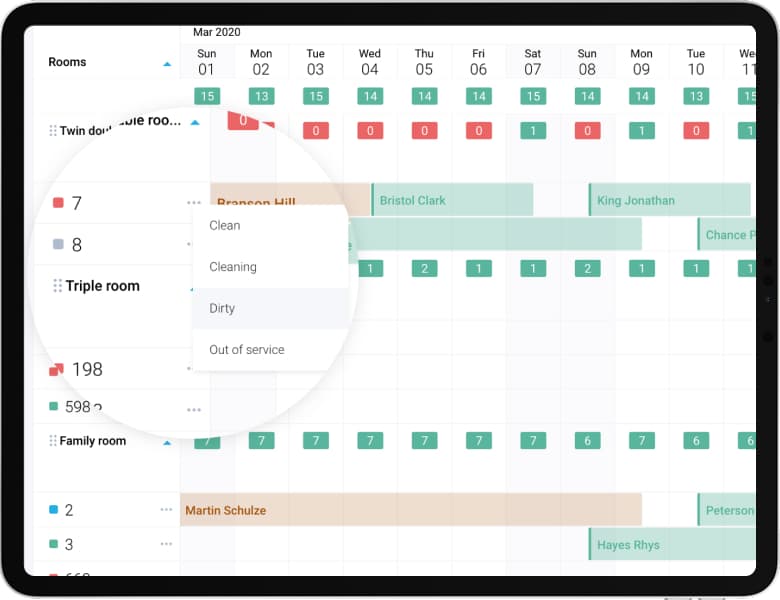
Digital housekeeping begins with agreed status rules. Define who marks a room dirty, clean, inspected, or out of order. Test checkout, room moves, early arrivals, re-cleaning, maintenance faults, and supervisor approval.
A mobile task list is useful only when it shows the correct room, priority, and notes. Check access on the devices staff will use and in weak-connectivity areas. Maintenance issues also need a route into room availability when a fault prevents sale.
Measure whether the process makes exceptions visible and reduces avoidable calls or duplicate records. Do not assume that creating more automated tasks produces better operations.
Treat payments and finance as controlled workflows
A hotel payment may touch the booking engine, PMS, payment provider, terminal, folio, and accounting system. Document which party handles funds and payment data. Test deposits, partial payments, refunds, chargebacks, tips, currency, settlement, and reconciliation.
Outsourcing card processing does not remove every merchant responsibility. The PCI Security Standards Council advises merchants to verify provider compliance, define shared responsibilities, and monitor provider status. Hotels should confirm their own obligations with their acquirer or other responsible organization.
Trace sample transactions into invoices, daily closing, reports, and accounting exports. Review corrections, permissions, and audit information. German tax, bookkeeping, fiscal, invoice, and retention requirements depend on the system configuration and the hotel’s procedures. Qualified advisers should review the actual setup.
Route guest communication into accountable work

Digital channels can carry confirmations, arrival instructions, service information, and guest requests. Decide which inbox or task queue owns each message and how urgent issues are escalated. A new channel adds risk if no one monitors it.
Guest-facing pages or apps can present bookable services. The hotel still needs accurate descriptions, capacity, prices, fulfillment, and cancellation rules. Technology alone does not guarantee extra revenue or guest satisfaction.
Separate service messages from marketing. Define the lawful basis and consent where required. Keep access, retention, unsubscribe, and suppression rules aligned across systems.
Set clear controls for hotel groups
A group may need shared employee access, portfolio availability, central rates, common company records, and consolidated reports. Central control should not erase required local differences. Define which settings are global, which are property-specific, and which roles may change them.
Test transfers between properties, local taxes, shared staff, reporting definitions, and access boundaries. Where currencies, languages, or legal entities differ, include them in the design. A dashboard is trustworthy only when every property uses the same documented definitions.
Choose an integrated platform or specialist stack deliberately
An integrated platform can reduce contracts, logins, interfaces, and support boundaries. It may suit a hotel whose main workflows are covered by the included modules. One vendor does not always mean one database or one technical product, so ask how the components connect.
Specialist applications may provide deeper functions for restaurants, events, revenue, CRM, locks, or finance. They can also make individual components easier to replace. The trade-off is more interface monitoring, contract management, and support coordination.
Current providers such as Mews, Cloudbeds, and Oracle describe broad cloud platforms alongside integration ecosystems. These are vendor positions, not proof that one design is universally better. AHLA/HTNG’s 2026 guidance supports careful attention to APIs, shared data models, and repeatable integration patterns.
Make privacy and security part of the design
Hotels process identity, contact, stay, preference, and payment-related data. Under the GDPR, personal data needs a lawful and stated purpose. Collection should be limited to what is necessary, retention should be controlled, and suitable safeguards are required.
A cloud provider that processes personal data for the hotel needs an appropriate controller–processor arrangement. The European Commission notes that contracts should cover documented instructions, confidentiality, security, assistance, and subprocessors. The hotel should also understand what happens to personal data when the service ends.
Use individual accounts, job-based permissions, strong authentication, prompt removal of departed users, and regular access reviews. Maintain tested backups and a recovery plan. Germany’s BSI recommends treating cybersecurity as a management responsibility, training staff, and testing backups rather than merely creating them.
Calculate total cost of ownership
Compare more than the monthly licence. Include setup, data cleaning, migration, interfaces, payment charges, hardware, locks, kiosks, training, support tiers, website work, custom changes, and internal project time. Estimate the cost of running both systems during transition.
Review renewal terms, usage limits, price changes, minimum commitments, and support coverage. Ask for export formats, termination assistance, and the period during which records remain available. Concentrating functions with one vendor can simplify accountability while increasing switching impact.
Plan adoption before go-live
Technology changes roles and decisions. Include front desk, housekeeping, finance, revenue, food and beverage, management, and data-protection stakeholders where their workflows are affected. Name a process owner rather than leaving the project solely with a vendor.
Train with real scenarios and role-specific permissions. Give staff a safe test environment where possible. Publish short procedures for routine work, exceptions, escalation, and downtime. Schedule extra support around cutover and avoid launching during a known peak period.
After launch, review unresolved errors and workarounds before buying more modules. Adoption means staff can complete the intended process and understand the source of truth. Login counts alone do not establish success.
A practical project roadmap
- Map the workflow. Record systems, files, owners, handoffs, volumes, and exceptions.
- Define the outcome. State what should change and how acceptance will be judged.
- Separate requirements. Mark legal needs, operational essentials, useful options, and later ideas.
- Clean source data. Resolve duplicates, room mappings, rates, taxes, and old accounts.
- Test real cases. Ask each shortlisted vendor to run the same routine and exception scenarios.
- Review the contract. Check costs, support, security, privacy, availability, recovery, export, and exit.
- Pilot and reconcile. Use acceptance criteria, trained users, and a fallback plan.
- Stabilize before expanding. Resolve defects and measure the workflow before adding scope.
What to ask when choosing hotel software
- ● Which system owns reservations, availability, rates, guest profiles, payments, and financial records?
- ● Which required functions are native, integrated, partner-operated, or custom?
- ● How are interface errors detected, retried, reconciled, and supported?
- ● Can roles follow actual job duties and separation-of-duty rules?
- ● What uptime, backup, recovery, maintenance, and incident terms are contractual?
- ● What will setup, migration, training, integrations, transactions, support, and exit cost?
- ● How can the hotel export complete, usable data and documents?
- ● Which customer procedures remain necessary for privacy, security, tax, and accounting duties?

How HotelFriend supports digital hotel operations
HotelFriend’s current product pages describe a cloud PMS with reservation and guest or company records. They also list housekeeping, tasks, reports, invoices, payments, a Booking Engine, Channel Manager, guest-facing tools, multi-property functions, and third-party integrations.
These are HotelFriend’s first-party descriptions. They do not show that every module is included in every plan or market. They also do not prove that the platform will improve revenue, occupancy, productivity, direct bookings, costs, or guest satisfaction for a specific property.
Hotels should verify the exact configuration, connector, payment route, data flow, fee, support level, and contract. Current package information is available on HotelFriend’s pricing page. The article does not quote a package price or trial because those commercial details are not needed to explain the selection process.
Conclusion
A sound hotel technology project starts with one controlled workflow and expands only after it works. The PMS may act as the operational core, but booking, distribution, payments, finance, guest services, and specialist tools must still exchange reliable information.
Choose software through realistic tests, complete cost analysis, clear data ownership, secure operating procedures, and an exit plan. Keep staff involved and preserve support for guests who cannot or do not want to use self-service. Digital tools create value only when the hotel can operate the resulting process with confidence.
