Introduction: Why group bookings are still a major challenge for hotels
When talking about the hotel industry, it is impossible to ignore group bookings. They provide a steady flow of guests, help hotels during the low season, and generate significant revenue. Tour groups, corporate events, large conferences, sports teams, or school trips – these are exactly the segments worth competing for.
At the same time, working with groups remains a major challenge due to inefficient internal processes. Outdated tools, fragmented information, and manual data entry lead to mistakes, overworked staff, and ultimately dissatisfied guests. In this article, we look at the most common group booking challenges and show how hotels can automate processes and improve profitability.
Challenge No. 1: Complex and time-consuming communication
Group bookings require particularly complex communication. Tour operators, corporate clients, and agencies reach out through different channels such as email, messengers, or phone, while arrival dates, guest numbers, and special requests keep changing. This can quickly result in an overwhelming stream of messages and enquiries.

In this flood of information, important details can easily get lost. If the team is unsure which information is up to date, the risk of errors increases shortly before arrival – creating stress for staff and negatively affecting the guest experience.
Solution
To bring order to the communication around group bookings, hotels need a technological foundation that connects everyone involved. A central PMS combined with an OTA MessageHub is particularly important, as it brings together all communication with tour operators, corporate clients, and agencies.
Instead of scattering information across emails, messengers, and phone calls, all enquiries, changes, and agreements are documented in one place. This makes it easy to see which information is current at any time. Misunderstandings are reduced, important details are less likely to be missed, and the team can work more efficiently and with less stress.
Challenge No. 2: Frequent changes and last-minute adjustments
Group bookings rarely remain unchanged. Services, arrival times, or the number of guests can – and in most cases will – be adjusted several times before arrival. For hotels, this means staying constantly available and updating every change in the system without delay.
Last-minute adjustments are especially stressful. If information gets stuck within one department, operational problems are almost inevitable.
Solution
Group bookings require maximum flexibility – and this is exactly where manual work quickly reaches its limits. Modern hotel software must allow changes to be made directly at reservation level in the PMS without putting existing bookings at risk.
A powerful system supports adding or removing guests, adjusting stay dates for individual travellers, and splitting invoices between individual guests, sub-groups, or companies. At the same time, all departments – Front Office, Housekeeping, F&B, and Accounting – are automatically informed about every change. This allows hotels to remain flexible even with last-minute adjustments and avoid operational errors.
Challenge No. 3: Revenue management and pricing complexity
One of the biggest challenges in group bookings is revenue management. Long booking lead times, blocked room allocations, and uncertain guest numbers make pricing and occupancy forecasting more difficult. Hoteliers often have to choose between selling room blocks too cheaply or keeping rates high and risking empty rooms.
Revenue losses are particularly common when group rates remain unchanged for months.
Solution
Effective Revenue Management for group bookings requires transparency across availability, rates, and occupancy. A CRS plays a central role here, as it manages prices and inventory across channels while staying connected to the PMS.
With real-time data, hotels can adjust group rates flexibly, make better use of revenue opportunities, and base pricing decisions on data rather than intuition.
Challenge No. 4: Coordination between departments
Group bookings involve almost every department within a hotel. If information is not shared systematically, each department can quickly end up working with its own “version of the truth.”
These information gaps lead to delays, rooms that are not prepared on time, and ultimately dissatisfied guests.
Solution
Smooth preparation for group arrivals is only possible when all departments work with the same information. This requires integrated systems, particularly close integration between the PMS and housekeeping software.
As soon as changes are made to a group booking, they automatically become visible to all relevant teams. Housekeeping knows which rooms need to be prepared and when, the Front Office is ready for arrivals, and F&B can plan services accordingly. Clear responsibilities and transparent data ensure coordinated workflows without unnecessary back-and-forth communication.
Challenge No. 5: Managing guest expectations in a group setting
Working with groups requires balancing the organiser’s requirements for time and budget with the individual expectations of guests, which can often conflict with one another.

If groups are treated as one homogeneous unit rather than as individual guests, a lack of personalisation can quickly lead to dissatisfaction.
Solution
Even within group bookings, guests expect an individual and seamless stay. Modern software helps hotels manage groups efficiently while still creating personalised experiences.
With flexible reservation structures in the PMS, digital communication, and automated check-in processes, hotels can combine standardised workflows with personal service. Guests receive relevant information at the right time, individual requests can be accommodated, and check-in becomes significantly smoother even for large groups. This way, every guest feels recognised despite being part of a group.
How technology can help hotels overcome group booking challenges
Many of the challenges associated with group bookings are caused by manual and fragmented processes. Modern hotels are therefore increasingly turning to digital tools, integrated systems, and automation to simplify group booking management.
When routine processes are automated, the risk of human error is reduced to a minimum. This allows staff to focus on what matters most – personal interaction with guests – while technology helps them act as true hosts rather than simply database operators.
Conclusion: Turning group bookings from a burden into an opportunity
Group bookings are complex for hotels, but they are also extremely valuable. Since most challenges are process-related, more and more properties are turning to integrated digital solutions.
A modern hotel operation therefore needs an integrated software environment that connects every area: a powerful PMS for reservations and billing, a CRS for availability and pricing, housekeeping software for operational workflows, and an OTA MessageHub for centralised communication.
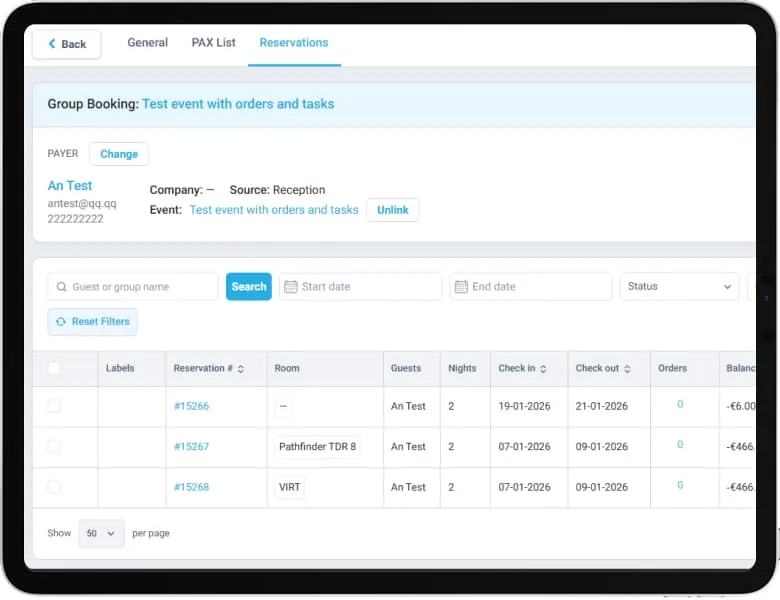
HotelFriend brings all these components together in one integrated platform. The ecosystem covers PMS, CRS, Housekeeping, OTA Messaging, flexible group billing, and dynamic reservation management, enabling hotels to manage even complex group bookings efficiently, transparently, and profitably.