
The hotel industry in Germany, Austria, and Switzerland is undergoing a profound transformation. Digitalization is no longer an option but a necessity for economic success. At the heart of this transformation is the Property Management System (PMS), the core of every hotel operation. For a long time, monolithic "all-in-one" systems dominated the market. However, these rigid architectures are increasingly reaching their limits. They are often expensive, inflexible, and can hardly keep up with rapid technological developments and changing guest expectations. The future, therefore, belongs to a new generation of systems: A modular PMS for the DACH region offers the agility and adaptability that modern hotels need to remain competitive. Instead of being dependent on a single, closed system, a modular architecture allows hoteliers to select and seamlessly integrate the best specialized tools for every area of their operation. This flexibility not only enables an increase in efficiency but also the creation of unique and personalized guest experiences. A modern Hotel Management System today must do more than just manage bookings; it must be an open ecosystem that grows with the hotel. Evaluating the right Property Management Software in comparison is therefore a crucial strategic step.
Brief Overview: Monolithic vs. Modular PMS Architectures
To understand the strategic importance of modular systems, one must know the fundamental difference from monolithic architectures. A monolithic PMS is designed as a closed software package where all functions—from reservations and housekeeping to billing—are tightly interconnected in a single, inseparable block of code. Any change or extension, even to a small function, requires intervention in the entire system. This makes updates complex, risky, and slow. A hotelier in Vienna who simply wants to integrate a new payment method like TWINT for his Swiss guests might have to wait months for an update from the manufacturer with a monolithic system. In contrast, a modular PMS consists of independent but interconnected building blocks or modules. Each module performs a specific task, such as Housekeeping , and communicates with the others via standardized interfaces (APIs). This architecture offers unprecedented flexibility. If the Viennese hotelier needs the TWINT integration, a corresponding payment module can simply be connected without affecting the rest of the system. This agility allows hotels to react quickly to market changes, adopt new technologies, and design their operational processes exactly according to their needs.
Features of Monolithic Systems:
- ● All functions in a single codebase.
- ● Low flexibility for customizations.
- ● Slow and costly update cycles.
- ● High dependency on a single provider.
- ● Difficult integration of third-party software.
Features of Modular Systems:
- ● Independent, interchangeable functional modules.
- ● High flexibility and scalability.
- ● Rapid implementation of new functions.
- ● Open architecture through APIs.
- ● Ability to combine "best-of-breed" solutions.
Scalability and Total Cost of Ownership with a Modular PMS for DACH
The choice of a PMS architecture has a direct impact on the long-term profitability of a hotel operation. The Total Cost of Ownership (TCO) is often deceptive with monolithic systems. While the initial license fees may seem clear, they often hide high costs for customizations, maintenance, and the forced purchase of feature packages that the business does not even need. A 25-room boutique hotel in Berlin might pay a monolithic provider for an extensive conference room management tool that it will never use. This inefficiency unnecessarily drives up the TCO.
A modular PMS for the DACH region offers a fundamentally different approach. Hotels only pay for the modules they actually need. The Berlin boutique hotel can start with the core modules for reservations, billing, and an integrated Channel Manager. If the business grows and, for example, opens a small spa area, a corresponding module can simply be added. This needs-based scalability not only lowers the initial investment but also keeps ongoing costs lean and transparent. According to an analysis by the Fraunhofer Institute, hotels can reduce their operating costs by up to 20% by using modular IT systems, as they do not waste resources on unused software functions. Transparent pricing, as is common with providers like HotelFriend, protects against unexpected expenses and allows for precise budget planning, which is a decisive competitive advantage, especially for independent hotels in the DACH region.
The Power of APIs: Integrations and the Third-Party Market
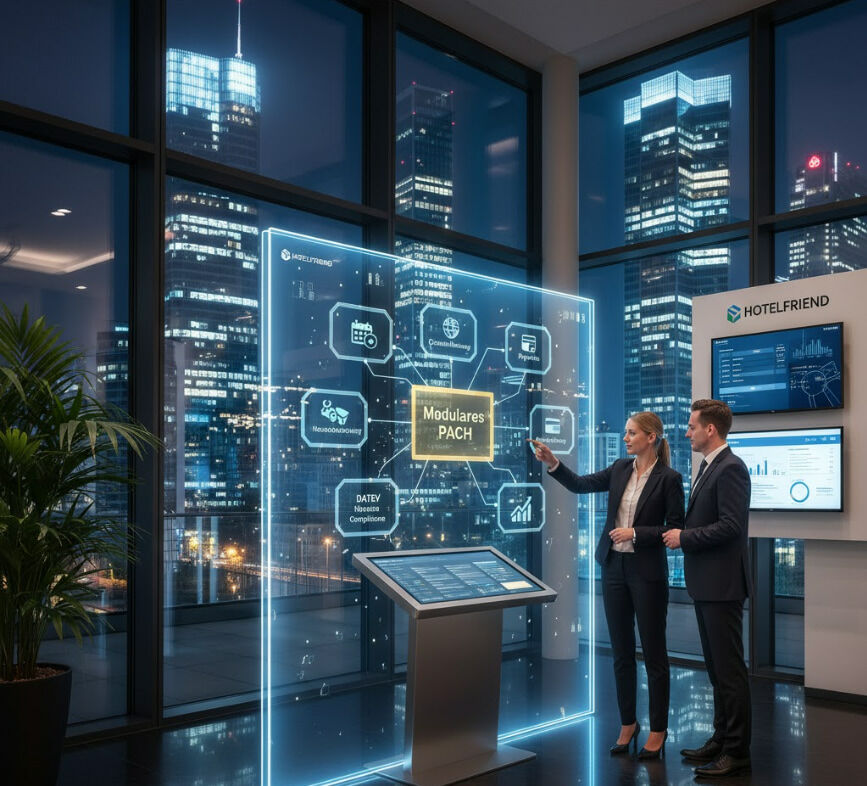
The backbone of any modular PMS is its Application Programming Interfaces (APIs). APIs act as universal translators that allow different software applications to communicate and exchange data seamlessly. In a monolithic world, integrating external tools is often a nightmare—expensive, time-consuming, and error-prone, if possible at all. An open API architecture, on the other hand, transforms the PMS from an isolated island into a connected ecosystem. This opens up a world of possibilities for hotels in the DACH region to individually design and optimize their technological landscape.
For example, a hotel in Zurich can easily connect its modular PMS with a local lock system provider like Salto, a POS system for the hotel restaurant, and a specialized revenue management tool. The data flows automatically: when a guest checks in online, the lock system receives the information to generate a digital key. At the same time, the room cleaning is informed via the Housekeeping module. All revenues from the restaurant are booked directly to the guest's bill in the PMS. This automation reduces manual errors, relieves employees, and increases efficiency throughout the entire operation. The ability to access a growing market of third-party applications also promotes innovation. Hoteliers are no longer dependent on the development speed of a single provider but can flexibly integrate the best and most innovative solutions for each business area. A look at the available integrations shows what a modern ecosystem can look like.
Why DACH Businesses Have Special Requirements for Their Hotel Software
The hotel market in Germany, Austria, and Switzerland is unique and places specific demands on hotel software that global providers often cannot meet. These requirements are a mix of strict legal frameworks, a special operational structure, and high expectations for data protection and security. A PMS originating from the US market that has merely been translated into German can hardly meet these local needs. For example, GoBD compliance (Principles for the proper management and storage of books, records, and documents in electronic form and for data access) is a legal requirement in Germany. A non-compliant system can lead to significant penalties during a tax audit.
Similarly, Austrian businesses must comply with the Cash Register Security Regulation (RKSV), which requires a complete and tamper-proof record of all cash transactions. In addition, the General Data Protection Regulation (GDPR), which applies throughout the EU, is implemented with particular care in the DACH region. A modular PMS for DACH, developed from the ground up for this market, natively incorporates these legal requirements. It not only offers the necessary certifications but also interfaces to local software like DATEV for accounting. Another important aspect is support. A hotelier from Munich who has an urgent problem with his booking system needs immediate help from a German-speaking expert who understands the local conditions—a service that global providers with call centers overseas often cannot provide. The choice of a hotel software is therefore always a decision for a partner who knows the regional rules of the game.
Data Sovereignty and Compliance: GDPR, GoBD, and RKSV in Focus
In a digitized world, data is a hotel's most valuable asset. Maintaining sovereignty over this data while complying with all legal regulations is of crucial importance for hoteliers in the DACH region. The legal frameworks are strict, and violations can have existence-threatening consequences. The General Data Protection Regulation (GDPR) governs the handling of guests' personal data and requires the highest standards for storage and processing. A hotel in Salzburg must ensure that guest data is hosted securely, ideally on servers within the EU, and that all processes from booking to check-out are GDPR-compliant.
Furthermore, tax law requirements must be observed. The German GoBD requires the unchangeable and traceable storage of all tax-relevant digital documents, such as invoices and receipts. In Austria, the RKSV places similar demands on cash register systems. A modular PMS developed specifically for the DACH market, like the solution from HotelFriend, integrates these compliance requirements from the ground up. It ensures that invoices are archived in a GoBD-compliant manner and that cash data is recorded in a tamper-proof way. This gives hoteliers the legal security to concentrate on their core business. The choice of the right Hotel Management System is thus also a safeguard against legal risks.
Checklist for Compliance in the DACH Region:
- ● GDPR Compliance: Is guest data processed securely and in accordance with the law?
- ● Server Location: Are the servers located within the EU to avoid data transfer to third countries?
- ● GoBD Compliance (DE): Is the archiving of invoices and receipts audit-proof?
- ● RKSV Support (AT): Is the POS system certified and tamper-proof?
- ● DATEV Interface: Is there a prepared interface for easy data export to the tax advisor?
- ● Data Processing Agreement (DPA): Is there a legally secure DPA with the PMS provider?
Migrating to a Modular PMS for DACH Without Business Interruption
The fear of a complicated and risky system change prevents many hoteliers from replacing their outdated PMS. A system change is often associated with weeks of training, data loss, and disruptions to ongoing operations. Especially in the high season, no hotel can afford such an interruption. This is where another decisive advantage of a modular architecture becomes apparent: the possibility of a gradual and controlled migration. Instead of a "big bang" switch, where the entire old system is shut down on a single day and replaced by the new one, a modular PMS for DACH allows for a smooth transition. For example, a hotel in Hamburg can start by implementing only the new Booking Engine on its website to optimize direct bookings. The old PMS continues to run in the background. In the next step, the channel manager is switched over to modernize the connection to the OTAs. Only when these core components are running stably and the staff is familiar with them are the remaining modules such as front office, billing, and housekeeping migrated. This phased approach significantly minimizes the risk. Data from the old system can be transferred gradually and validated. Employees are not overwhelmed with a flood of new functions but can concentrate on learning individual modules. Providers like HotelFriend support this process with dedicated onboarding specialists who accompany the entire transition and ensure that hotel operations are not endangered at any time. Careful planning and the choice of the right partner make the migration a manageable and successful project.
Case Study: How a Hotel in Munich Benefits from a Modular PMS
To illustrate the theoretical advantages, let's look at a concrete example: An independent 80-room city hotel in Munich used a monolithic, locally installed PMS for years. The system was slow, the user interface was outdated, and integrating new services like online check-in or mobile door locks was impossible. The costs for maintenance contracts increased annually without providing any real added value. The hotel manager decided to switch to a cloud-based, modular PMS from HotelFriend.
The migration was carried out in three phases:
Phase 1 (Sales & Rate Management): First, the cloud-based Booking Engine and the Channel Manager were implemented. Within four weeks, the direct booking rate on the hotel website increased by 15% because the new booking mask was more mobile-friendly and allowed for dynamic pricing.
Phase 2 (Operations): Next, the front office and housekeeping modules went live. Staff could now update room status in real-time via tablets, which drastically improved communication between reception and the floors and made rooms available again more quickly.
Phase 3 (Guest Experience & Payment): Finally, the payment module with Stripe integration and a connection to the Salto lock system were activated. Guests could now check in online, pay with their credit card, and receive a digital key on their smartphone.
The results after six months were impressive: The operating costs for the hotel software decreased by 25% because only the necessary modules were licensed. Employee satisfaction increased due to the intuitive, mobile workflows. Most importantly, guest reviews improved significantly because the entire stay, from booking to departure, was smoother and more modern. This example shows how a personalized guest experience can be created through technology.
Ecosystem Effects and the Pace of Future Innovation
The decision for a PMS architecture is more than just a technological choice; it is a strategic course setting for the future viability of the hotel. Monolithic systems create a dependency on a single provider and its innovation cycle. If this provider decides not to support a new technology like artificial intelligence or voice-controlled assistants, the hotelier has no choice but to do without it or switch the entire system. A modular, API-based PMS, on the other hand, opens the door to a global ecosystem of innovations.
This ecosystem consists of hundreds of specialized technology companies focused on developing the best solution for a very specific problem—be it the most advanced revenue management tool, the smartest chatbot software, or the most efficient platform for guest communication. Thanks to the open architecture, a hotelier can simply connect these "best-of-breed" solutions to their core PMS via API. The pace of innovation is thus no longer determined by the PMS provider alone, but by the dynamics of the entire market. A hotel in Switzerland can already benefit from new AI-powered price optimization software from a startup in Berlin by simply connecting it to its modular system. This ability to react quickly and flexibly to technological trends will become the decisive competitive factor in the coming years. A modern Hotel Management System is therefore less a product and more a platform that enables and promotes innovation.
Choosing the Right Architecture: A Comparison of PMS Systems
When selecting a new PMS, hoteliers are faced with a multitude of providers. To make an informed decision, a structured comparison is essential. The following table contrasts the most important criteria and shows the differences between a native DACH provider with a modular architecture and typical global or outdated systems.
|
System Name |
DACH Market Focus |
Key Features |
Pricing Model |
Integration Partners |
Support Quality |
|
HotelFriend |
Native DACH Focus |
Integrated Channel Manager, GoBD/RKSV compliant, Housekeeping Module, Booking Engine, Revenue Management |
Transparent Subscription Model |
Stripe, DATEV preparation, Salto, WuBook |
German-speaking teams in DE/AT/CH |
|
Competitor A (Global Cloud) |
Limited, translated version |
Generic features, often lacking local adaptations |
Enterprise contracts, often non-transparent |
Global partners, local providers often missing |
English-speaking support, time zone differences |
|
Competitor B (Monolithic) |
Outdated, often only national |
Rigid all-in-one solution, no flexibility |
High license fees + expensive maintenance contracts |
Hardly any, proprietary interfaces |
Slow support due to outdated structures |
|
Competitor C (Open Source) |
No focus, do-it-yourself |
Basic functions, everything else must be developed |
No license fees, but high development & maintenance costs |
Dependent on developer community |
No official support, only forums |
The table illustrates that pure functionality should not be the only decision criterion. A system like HotelFriend was designed from the ground up for the specific legal and operational requirements of the DACH market. This is reflected not only in features like GoBD compliance but also in the choice of integration partners and, above all, in the local, German-speaking support . Global providers can hardly offer this degree of specialization and service quality for the DACH region. Investing in a future-proof, modular architecture with a strong local partner is therefore an investment in the long-term competitiveness of one's own business.
Consequences for Providers and Hoteliers: A Modular PMS for DACH as a Strategic Advantage
The unstoppable trend towards modular architectures has profound consequences for the entire hotel technology industry. For PMS providers, this means the end of the "walled garden" strategy. Instead of trying to keep customers trapped in a closed system, they must open up and become platform providers that foster a thriving ecosystem of partners and integrations. Providers who cling to their monolithic structures will increasingly lose relevance as they can no longer keep up with the market's pace of innovation. The focus is shifting from trying to do everything best themselves to orchestrating the best available solutions for the hotelier.
For hoteliers, this development means one thing above all: more freedom, more control, and more opportunities. They are no longer forced to compromise on their software. Instead, they can build a technology landscape that is perfectly tailored to their unique business concept, their target audience, and their strategic goals. A modular PMS for DACH thus transforms from a mere administrative tool into a strategic lever for efficiency, guest satisfaction, and profitability. The selection of the PMS is therefore one of the most important entrepreneurial decisions a hotelier has to make today. It's not just about how bookings are managed, but about how agile, innovative, and future-proof the entire operation is. The consideration of the costs of a PMS should therefore always include an assessment of the strategic value of flexibility and scalability.
Actionable Recommendations for Forward-Thinking Decision-Makers
Switching to a modular PMS is a strategic investment in the future of your hotel business. For hoteliers and decision-makers in the DACH region planning this step, careful analysis and a structured approach are crucial for success. Start with a thorough inventory of your current IT landscape and identify the biggest pain points and inefficiencies. Which processes are too slow? Where do manual errors frequently occur? What wishes do your guests express that you cannot fulfill with the current system?
On this basis, define clear requirements for a new system. Prioritize not only functions but, above all, flexibility, integration capability, and compliance with local, DACH-specific regulations like GoBD and RKSV. Look for a partner, not just a supplier. A provider like HotelFriend, who understands the DACH market and offers German-language support, can make the decisive difference during migration and in daily operations. Don't hesitate to request a live demo and contact reference customers. A modular PMS for DACH is the key to successfully meeting the challenges of the future and keeping your business competitive in the long term. Inform yourself about transparent pricing models that grow with your company and actively shape the digital future of your hotel. Start planning today and secure the technological foundation for your success.