
The digital transformation has firmly taken hold of the hospitality industry, putting traditional operations to the test. In particular, the hotel reception — the heart of every establishment — is undergoing a fundamental change. Given the widespread shortage of skilled workers, rising operating costs, and the growing expectations of digitally savvy guests, it has become increasingly important for hoteliers in Germany, Austria, and Switzerland to automate their reception.
A hotel that still relies solely on manual processes today risks not only efficiency losses but also competitive disadvantages. Automating routine tasks such as check-in, check-out, payment processing, and guest communication is no longer a vision of the future but a strategic necessity. It allows staff resources to be used more effectively for personal guest service while optimizing overall operations.
A modern Property Management System (PMS) provides the technological foundation to unlock this potential. By intelligently integrating with a Channel Manager and a Booking Engine, it creates an ecosystem that not only increases efficiency but also improves guest satisfaction and boosts revenue per guest in the long term.
Why Automating the Hotel Reception Is Now Essential
The pressure on the hospitality industry in the DACH region has rarely been as high as it is today. According to a study by the DEHOGA Federal Association, more than 70% of hotels in Germany report a severe shortage of skilled workers — a situation mirrored in Austria and Switzerland. This lack of staff affects the reception desk particularly hard, as it serves as the central contact point of the hotel and ideally needs to be staffed around the clock.
The automation of repetitive tasks is therefore no longer a luxury but an economic necessity to maintain service quality. For example, a hotel in Berlin-Mitte with 80 rooms was able to ease the workload of its night shift and significantly improve employee satisfaction by introducing a digital check-in system.
At the same time, guest expectations are changing rapidly. A Statista survey shows that over 60% of travelers would prefer a completely contactless hotel stay. They want fast, hassle-free processes that can be managed directly from their smartphones. Hotels that fail to offer these digital services are increasingly perceived as outdated.
Thus, automating the reception directly addresses the two biggest challenges in the industry: internal resource shortages and external market demands. A powerful booking engine system is the first step toward providing guests with a fully digital journey — from booking to check-out.
First Steps Toward Automation: Define Goals and Analyze Processes
Before you begin automating your hotel reception, a thorough analysis of your existing workflows is essential. Acting too hastily without clear objectives often leads to poor investments and frustrated employees. Start by documenting the entire guest journey in detail — from booking to post-departure.
A mid-sized hotel in Vienna successfully applied this approach by forming an interdisciplinary team that included reception, housekeeping, and management. Together, they visualized every single step of the guest journey, uncovering numerous instances of manual data entry and redundant communication — ideal candidates for automation.
Throughout this process, strict GDPR regulations must be taken into account from the very beginning, especially regarding the collection and processing of guest data.
Once the analysis is complete, define clear and measurable goals. For example:
● Do you want to reduce check-in waiting times by 50%?
● Decrease the number of reception calls by 30%?
● Increase upselling conversion rates by 15%?
Checkliste zur Prozessanalyse an der Rezeption:
● Booking Management: How are bookings from different channels captured and confirmed?
● Pre-Stay Communication: What information do guests receive before arrival, and how is it sent?
● Check-In Process: What steps are required from the guest and the staff? How long does the process take on average?
● Payment Handling: How are deposits, final payments, and security deposits managed?
● Guest Communication During Stay: How are requests and inquiries handled?
● Housekeeping Coordination: How is room status communicated between reception and cleaning staff?
● Check-Out Process: How are invoices, payments, and key returns handled?
● Post-Stay Communication: How are feedback requests and marketing emails sent?
This detailed documentation forms the foundation for selecting the right technological tools and ensuring a successful implementation — ideally culminating in a comparison of hotel software solutions to identify the most suitable system for your property.
The Technological Core: PMS, Channel Manager, and Booking Engine
The successful automation of your hotel reception depends entirely on choosing the right technological foundation. At the center of this digital ecosystem lies the Property Management System (PMS). It is far more than a simple digital occupancy plan — it serves as the central hub for all hotel data and processes.
A modern, cloud-based PMS like HotelFriend’s system consolidates all essential information about guests, bookings, room status, and invoices in one place. For hotels in the DACH region, it is crucial that the system is GoBD-compliant — fully meeting the Principles for Proper Management and Storage of Books, Records, and Documents in Electronic Form as well as for Data Access. This ensures legally compliant bookkeeping and prevents issues during audits.
Closely connected to the PMS is the Channel Manager, which synchronizes your hotel’s availability and rates in real time across all connected online travel agencies (OTAs) such as Booking.com, Expedia, and Airbnb. This prevents double bookings and eliminates the considerable manual effort of maintaining inventory on multiple platforms.
The third key component is the Booking Engine, the reservation system on your own hotel website. A powerful Booking Engine allows guests to book directly and commission-free, select add-on services, and make secure payments.
The seamless integration of these three elements — PMS, Channel Manager, and Booking Engine — within a single platform, as offered by HotelFriend, is the key to achieving maximum efficiency. For example, a hotel in Zurich reduced manual booking entries by 95% and increased its direct booking rate by over 20% after switching to an integrated solution.
Automating the Hotel Reception: Contactless Check-In in Practice
The contactless check-in is often the most visible and impressive element of an automated reception. It transforms a potentially time-consuming procedure into a smooth and pleasant guest experience.
The process typically begins a few days before the guest’s arrival. Through the PMS, an automated email or SMS is sent, inviting the guest to complete the online check-in. Here, guests can conveniently enter all required information for the legally mandated registration form in Germany — including personal details and, if necessary, digital copies of ID documents — all fully compliant with GDPR regulations.
A city hotel in Munich uses this process to better predict guests’ arrival times and optimize staff scheduling at the reception. After submitting their data, the guest can sign digitally and then receives either a QR code or a link to a digital room key on their smartphone.
Upon arrival at the hotel, the guest can skip the traditional front desk and proceed directly to their room. Alternatively, a self-service kiosk in the lobby can be used to scan the QR code and print a physical key card — ensuring a flexible and efficient check-in experience for every type of traveler.
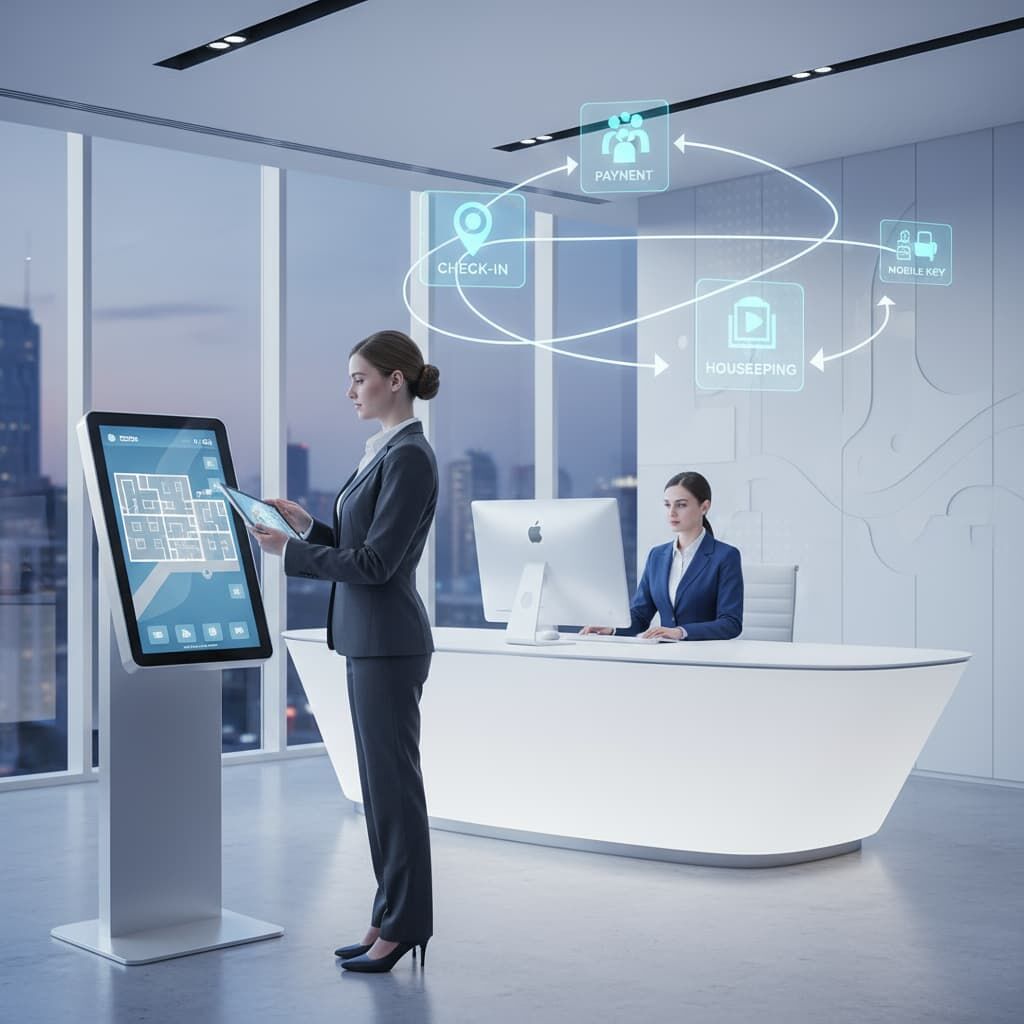
Schritte des automatisierten Check-ins:
● Pre-Arrival Email: Automatic message sent with a link to the online check-in.
● Digital Registration Form: The guest fills in all legally required information online.
● Document Upload: Secure upload of ID documents (optional).
● Digital Signature: Legally valid signing of the registration form.
● Online Payment: Credit card authorization or full payment for the stay.
● Digital Key: Delivery of a mobile room key or a code for a locker/kiosk.
● Welcome Message: Personalized greeting including all relevant hotel information.
This process not only significantly reduces waiting times and administrative workload but also opens up numerous opportunities for targeted upselling of additional services during the online check-in.
Secure and Efficient Payment Processing: Integration of Payment Gateways
Automating payment processes is a key driver of efficiency and error reduction at the hotel reception. Manual credit card entry, handling cash, and reconciling cash books are things of the past with a modern system. The integration of a Payment Service Provider (PSP) such as Stripe directly into your hotel payment processing is the cornerstone of this transformation.
When a guest books through the hotel’s own Booking Engine, their credit card can be securely tokenized and stored for future charges — such as deposits, cancellation fees, or the final invoice. This process fully complies with the highest PCI-DSS security standards, ensuring that no employee ever sees the complete card data.
For the DACH market, it’s also essential to offer local payment methods like Giropay in Germany, TWINT in Switzerland, or EPS in Austria to maximize the conversion rate for direct bookings.
A resort hotel on Lake Constance, for example, reduced its outstanding receivables by over 80% after implementing tokenized payments and automatic invoicing at check-out.
The entire workflow — from deposits to charging restaurant expenses to the room, through to final billing — is fully automated and GoBD-compliant. This not only simplifies daily operations but also streamlines the transfer of accounting data to tax consultants, especially when a DATEV interface is available.
Optimizing Housekeeping Workflows Through Automated Status Updates
An efficient reception is inseparably linked to smooth housekeeping operations. Automation builds a vital bridge between these departments, eliminating the typical communication errors that often lead to dissatisfied guests.
In a traditional hotel setting, communication about room status often takes place through phone calls, handwritten notes, or radios — all prone to mistakes and inefficiencies. A modern PMS with an integrated housekeeping module fully digitizes this process.
As soon as a guest checks out at the front desk (or completes a digital check-out), the room status in the system automatically changes to “dirty.” The housekeeping staff instantly see this update in real time on their tablets or smartphones via the housekeeping app. The app displays a prioritized list of rooms to clean, based on scheduled arrivals or specific guest requests.
A business hotel near Frankfurt Airport, for example, uses this feature to prioritize rooms vacated by early-departing guests. This enables early check-ins for new arrivals — a small operational improvement that consistently results in better guest reviews.
Once a room has been cleaned and inspected, the housekeeper simply updates the status in the app to “clean.” This information is immediately transmitted to the PMS and thus to the reception desk. The room then appears as available in the system and can be assigned for an early check-in — all without a single phone call.
Boosting Revenue Through Reception Automation
Automating the hotel reception is not only about reducing costs and increasing efficiency — it is also a powerful tool for maximizing revenue. By freeing staff from repetitive administrative tasks, you create space for proactive sales and more personalized guest interactions. At the same time, technology itself opens new opportunities to increase revenue per available room (RevPAR).
A key element here is Hotel Revenue Management. Modern PMS solutions can use algorithms that analyze market demand, historical booking data, local events, and competitor pricing to provide dynamic rate recommendations. These rates are then automatically distributed across all sales channels via the Channel Manager.
For example, a hotel in the Swiss Alps increased its occupancy during the low season by 15% and its average daily rate (ADR) during the high season by 10% by implementing such dynamic pricing automation.
In addition, automation enables targeted and personalized upselling. During the online booking process or digital check-in, guests can be presented with relevant add-on offers tailored to their preferences and stay duration.
Checklist for Automated Upselling:
● Room Upgrades: Offer upgrades to a higher room category at an attractive rate.
● Breakfast and Half Board: Sell meal options directly during the booking process.
● Spa Treatments or Activities: Suggest suitable experiences based on stay length and guest profile.
● Early Check-In / Late Check-Out: Monetize flexible arrival and departure times.
● Parking and Transfers: Provide practical add-ons that enhance convenience.
● Special Packages: Create themed offers (e.g., “Romantic Weekend”) with the Deals Composer.
These offers are presented to guests at the right moment in the booking journey and can be booked and paid for with a single click, often leading to a much higher conversion rate than traditional upselling at the reception desk.
Legal Frameworks in the DACH Region: GoBD, GDPR, and RKSV Compliance
Choosing hotel software in German-speaking countries is inseparably linked to meeting complex legal and regulatory requirements. A solution that fails to comply can lead to severe penalties in the event of an audit by tax authorities or data protection agencies. Therefore, it is essential to select a provider who truly understands the DACH market and its specific compliance landscape.
The three most important regulatory frameworks are GoBD in Germany, GDPR across the European Union, and RKSV in Austria.
The GoBD (Principles for Proper Management and Storage of Books, Records, and Documents in Electronic Form as well as for Data Access) requires unalterable and traceable recording of all tax-relevant data. A GoBD-compliant PMS ensures that every booking, invoice, and cancellation is fully documented and audit-proof.
The GDPR (General Data Protection Regulation) governs how personal guest data is collected, stored, and processed. The system must guarantee that data is stored securely, used only for its intended purpose, and deleted upon guest request — the so-called “right to be forgotten.” This applies especially to digital registration forms and guest communication.
In Austria, the RKSV (Cash Register Security Ordinance) additionally requires a technical security mechanism for all cash transactions to prevent tampering. A PMS with an integrated cash register module must comply with these regulations.
A hotel software solution developed specifically for the DACH market, such as HotelFriend, incorporates these legal requirements directly into its architecture — rather than retrofitting a global product to local standards.
Choosing the Right Hotel Software: A System Comparison for the DACH Market
Selecting the right software to automate your hotel reception is one of the most strategic decisions a hotelier can make. The market offers a wide range of providers, but they differ significantly in their focus, functionality, and level of service.
For hotels in Germany, Austria, and Switzerland, it is particularly important to choose a partner who not only understands local requirements but also prioritizes them in product development. Many international systems offer a German interface, yet their core design is often tailored to the Anglo-American market. This can lead to compliance issues with local tax regulations (GoBD, RKSV), missing integrations with regional partners (e.g., DATEV), and customer support that lacks understanding of local operational challenges.
A system natively developed for the DACH region provides a clear competitive advantage. The table below compares HotelFriend with generic competitors to highlight key differentiators.
| System Name | DACH Market Focus | Key Features | Pricing Model | Integration Partners | Support Quality |
|---|---|---|---|---|---|
| HotelFriend | Natively developed for DACH | Integrated Channel Manager, Booking Engine, GoBD/GDPR compliance, Housekeeping App, Revenue Management, Deals Composer | Transparent subscription model | Stripe, DATEV (in progress), Salto, Booking.com, Airbnb | German-speaking support teams in DE/AT/CH, 24-hour response |
| Competitor A (Global) | Translated version, limited focus | Generic PMS functionality | Complex, often enterprise contracts | Global partners, few local ones | Primarily English-speaking, call center-based |
| Competitor B (Legacy) | Outdated DACH focus | On-premise, limited cloud capabilities | High upfront costs + maintenance | Few, often outdated integrations | Slow response times |
| Competitor C (Modern) | EU focus, not DACH-specific | Good UI design, but lacks compliance depth | Per-booking fees | Focused on new tech partners | Online/chat support only |
The ideal choice is a system that combines strong technology with a deep understanding of local legal and operational requirements, serving as a reliable long-term partner for your hotel’s growth.
Conclusion
In today’s market, the decision to automate your reception is far more than a technical upgrade — it is a strategic move toward a sustainable and profitable future. Automating routine processes such as check-in, payment handling, and interdepartmental communication not only relieves your staff of administrative tasks but also increases efficiency, reduces errors, and enhances the guest experience.
For hoteliers in the DACH region, choosing the right technology partner is key. A solution like HotelFriend, developed specifically for the needs of the German, Austrian, and Swiss markets, provides decisive advantages. Its native compliance with GoBD, GDPR, and RKSV, the seamless integration of PMS, Channel Manager, and Booking Engine, and a German-speaking support team that understands local operations ensure both security and effectiveness.
Invest in an all-in-one solution that grows with your business and gives you the freedom to focus on what truly matters — delivering exceptional hospitality.
Explore our transparent pricing models or request a free, no-obligation demo today.