
Hotel Software Comparison: How to Find the Right Solution for Your Business
Compare leading hotel software solutions and learn how to choose the right system for your property. Discover key features, evaluation criteria, and expert tips to help you streamline operations and improve guest service.
Dec 8, 2025 2:09 PM
A hotel software comparison is one of the most important strategic decisions you can make. This is not an exaggeration. The right choice can increase your revenue by up to 20% and give your team valuable time back. An outdated solution, on the other hand, leads to inefficiency, double bookings, and frustrated guests. Your decision directly affects occupancy, administrative workload, and guest satisfaction — and therefore the long-term success of your property.
Why a thorough hotel software comparison makes all the difference
Searching for the right hotel software is more than just a technical task; it is a strategic investment in the future of your business. Outdated or unsuitable systems are not only a daily annoyance but can also cause real financial damage. Manual data entry, missing synchronization, and cumbersome workflows lead directly to double bookings, loss of revenue, and—worse—dissatisfied guests who do not return.
For you as a hotelier, this means one thing clearly: the right software is not just a cost factor but an investment that pays off. It is the tool that enables you to remain competitive and respond flexibly to constantly changing market demands.
The tangible benefits for your business
A careful hotel software comparison protects you from costly mistakes and helps you find a solution that fits your property perfectly. The advantages of a well-considered choice become noticeable immediately in daily operations:
● Higher occupancy and increased revenue: By centrally and automatically managing all booking channels, overbookings become a thing of the past. This maximizes room utilization and allows you to implement pricing strategies more effectively.
● Less administrative work for your team: From booking to invoicing, everything runs automatically. This significantly reduces your staff’s workload, minimizes errors, and gives employees more time to focus on what truly matters: the guest.
● A better guest experience: Smooth check-ins, personalized communication, and quick responses to inquiries sustainably improve guest satisfaction. This leads to better ratings and more direct bookings.
This guide is your practical compass. We don’t just analyze technical features — we show you how they improve your daily operations and what steps you can take to make the best decision for your hotel.
A Look at the System Architectures
Before comparing individual providers, you should understand the basic system types. Each approach offers its own advantages and disadvantages that directly affect your operations, costs, and flexibility.
|
System Type |
Main Advantage |
Main Disadvantage |
Ideal for |
|
All-in-One Cloud Solution |
All modules (PMS, Channel Manager, Booking Engine) are seamlessly integrated. Low maintenance effort, mobile access. |
Less flexibility when connecting highly specialized third-party tools. |
Hotels looking for a simple, integrated, and future-proof solution without an in-house IT department. |
|
Modular Best-of-Breed |
You assemble your system from the best individual applications for each area. Maximum flexibility. |
High integration effort and potential compatibility issues. Multiple contracts and points of contact. |
Larger hotels or chains with specific requirements and internal IT expertise that need a customized technology landscape. |
|
Legacy On-Premise System |
The software is installed locally on your own servers, giving you full control over your data. |
High acquisition and maintenance costs, no mobile access, often outdated technology and security risks. |
Operations with strict requirements for local data storage and an in-house IT department. A declining model for most hotels. |
Expert Insight: The trend is moving steadily toward the cloud. A modern, cloud-based all-in-one system offers the best balance of functionality, cost efficiency, and future readiness for the vast majority of hotels. It eliminates the complexity of interfaces and allows you to focus on what truly matters: your guests.
In the following sections, we guide you through the key evaluation criteria and help you find the perfect software for your specific operation.
The Foundation: The Property Management System (PMS)
The Property Management System (PMS) is the nerve center of your hotel. This is where everything comes together – from the first reservation to check-in, billing, and housekeeping. A modern PMS today must be far more than just a digital room calendar.
Ask yourself:
● How intuitive is the interface really? Can new employees get started right away after a short introduction, without weeks of training? That saves you time and money.
● How flexible is the reporting? Can I get the numbers I need for my business decisions at the push of a button – occupancy, RevPAR, guest structure?
● Does the system automate what can be automated? Are routine tasks such as sending booking confirmations or invoices handled automatically so my team has more time for guests?
A good PMS takes manual work off your plate. The result: happier guests, fewer errors, and more time for strategic tasks.
The Bridge to the World: The Channel Manager
The Channel Manager is your most important employee in online distribution. It synchronizes your availability and prices in real time across all connected portals such as Booking.com or Expedia. Its core task is simple but vital: avoiding overbookings and distributing your pricing strategy cleanly across all channels.
Expert Insight: A powerful Channel Manager is not a luxury but an absolute necessity. It is the tool that allows you to maximize your online visibility without losing control. In today’s dynamic booking landscape, manually maintaining channels is no longer feasible and inevitably leads to revenue losses.
When evaluating, pay particular attention to the number and quality of connected channels. Are the portals included that are relevant to your target audience? And, most importantly: How stable and fast is synchronization in practice?
The Direct Line to the Guest: The Booking Engine
The Booking Engine is your own online shop on your hotel website. Its goal is clear: to generate more direct bookings and reduce the high commissions paid to OTAs. A first-class booking engine is easy to use, works perfectly on mobile and desktop, and visually integrates with your website.
The booking process for the guest must be as simple and short as possible—ideally only a few clicks. Crucial features include offering additional services (upselling), integration with secure payment providers, and the ability to easily redeem discount codes.
What Really Matters When Choosing Your Hotel Software
A smart hotel software comparison is more than just checking off a list. It’s about seeing the bigger picture — how each individual component affects your daily operations, your team’s efficiency, and ultimately your revenue. The key question is not: “What can the software do?” but: “What does the software actually do for my hotel?”
To separate the good from the bad, you need to understand the core pillars of any professional hotel software. It’s not isolated features that make the difference, but the seamless interaction of the essential modules. A system is only as strong as its weakest link.
The Decisive Criterion: Seamless Integration
The true value of a hotel software solution only becomes apparent when the three core components – PMS, Channel Manager, and Booking Engine – work together flawlessly. If they do not operate as a well-coordinated team, data silos, manual corrections, and frustration quickly arise. Real integration means this: A booking made on your website instantly updates availability across all OTAs and simultaneously creates a clean guest record in the PMS.
This trend toward fully integrated cloud systems is becoming increasingly strong. Industry reports show that in the past twelve months alone, more than 200 hotels in Germany and Austria have switched to such an all-in-one solution. Read more about the reasons why modern hoteliers choose cloud systems at 42-gmbh.de.
This seamless interconnection is the foundation of an automated and profitable hotel operation.
Detailed Analysis of Core Software Modules
Once the fundamental system types are clear, it’s time to dive deeper. A genuine hotel software comparison doesn’t end with a simple feature list. We need to understand how these modules interact in real-world operations to truly move your hotel forward.
Think of the modules as gears in a large machine. If one gear jams, the entire engine stutters. For you, this means lost time, frustrated employees, and missed revenue.
The Heart of Operations: Reservation Management (PMS)
The Property Management System (PMS) is far more than just a digital occupancy plan. A meaningful test is how well it handles group bookings. For example: A company books 15 rooms for a seminar. A good PMS allows you to effortlessly create a group block with a dedicated rate plan, assign individual guest names, and split billing cleanly – some rooms charged to the company, others directly to the guests. A less capable system forces you into cumbersome manual workarounds that are error-prone and time-consuming.
The Essential Sales Channel: Channel Manager
The Channel Manager is your direct pipeline to the global market. Its main task: real-time synchronization of rates and availability. A delay of just a few minutes can lead to frustrating and costly overbookings, especially during peak season. A look at the most popular hotel booking portals in Germany shows that Booking.com holds a dominant market position. Seamless integration is therefore not a “nice-to-have” but an absolute necessity. Learn more about the latest hospitality trends and statistics on perk.com.
Expert insight: The true quality of a Channel Manager becomes evident in the depth of its integration. Can the system consistently apply complex pricing strategies such as dynamic pricing or yield management across all channels? This is where the real potential for revenue maximization lies.
The Direct Booking Engine
Your own website is your most profitable sales channel. A first-class Booking Engine is the key to attracting guests away from OTAs and securing commission-free bookings. The decisive factor is a perfectly smooth user experience. Guests must be able to complete a booking in no more than three clicks. High-quality Booking Engines also offer intelligent upselling options. During the booking process, they suggest suitable add-ons — whether a room upgrade, a spa package, or a late check-out. This increases the average booking value (RevPAG) and enhances the guest experience.
The following graphic clearly illustrates which criteria matter most for the core modules.
The data underscores how crucial a strong Booking Engine is for direct sales success.
Comparison of Key Hotel Software Architectures
This table helps you identify the approach that truly aligns with your operational goals.
|
Function Module |
All-in-One Cloud Solution |
Modular Best-of-Breed System |
Legacy On-Premise System |
Practical Benefits for Hoteliers |
|
Reservation Management |
Uniform, intuitive interface. Group bookings & rate plans are usually seamlessly integrated. |
Specialized PMS often offers deeper features but requires perfect synchronization. |
Functionality often limited & not very flexible with new rate models. Updates are time-consuming. |
An all-in-one solution simplifies daily operations and reduces training time, while best-of-breed systems are ideal for highly specialized needs. |
|
Channel Integration |
Preconfigured, stable connections to major OTAs. Updates are applied centrally. |
You choose the best channel manager on the market, but the interface to the PMS can be a weak point. |
Connections are often outdated & slow. Adding new channels is complex or impossible. |
Cloud systems provide peace of mind with OTA integration. With best-of-breed, you bear the risk of seamless interface performance. |
|
Housekeeping Module |
Fully integrated. Room status changes are instantly visible on staff mobile devices. |
Requires a separate app & interface. Real-time updates are not always guaranteed. |
Usually only a simple list in the PMS, without mobile integration or real-time status. |
Integrated modules greatly increase efficiency. A separate solution may offer more features but can lead to communication gaps. |
|
API Openness & Security |
Modern, open APIs for future integrations (e.g., POS systems). GDPR-compliant with high security standards. |
Very flexible since each module has its own APIs. Overall security depends on the weakest component. |
Closed system, hardly any integrations. Data security rests entirely on your shoulders. |
Modern APIs are your insurance for the future. They let you adapt to new technologies without replacing the core system. |
The table clearly shows: the right choice always depends on the individual hotel — its size, its processes, and its long-term strategy.
Selecting the Right Software for Your Hotel Type
Not every hotel software solution fits every type of property. A successful hotel software comparison always begins with an honest assessment: What does my business model truly need to perform at its best? The right software shouldn’t feel like a tool you have to manage. Instead, it should act as a silent partner that handles routine tasks, giving your team more time to focus on what truly matters — creating memorable guest experiences.
Boutique Hotels and Independent Properties
For boutique hotels, everything revolves around personalization and exceptional service. The software must support this promise.
Here are the features that matter most:
● Detailed guest profiles: The software should make it effortless to store preferences and past stays, enabling your team to proactively meet guest expectations.
● Focus on direct bookings: A seamlessly integrated booking engine is essential for promoting unique packages and offers that are not available on OTAs.
● Intuitive usability: In small teams where everyone wears multiple hats, a PMS that requires no lengthy onboarding is invaluable.
Expert insight: The biggest advantage for boutique hotels lies in personalization. Software with strong CRM capabilities gives you the data needed to make each stay unique and build genuine guest loyalty.
Hotel Chains and Multi-Property Groups
Hotel chains face an entirely different set of challenges: scalability, centralized control, and consistent standards. The software must act as the central nervous system that keeps the entire group connected.
Key aspects chains must focus on:
● Central Reservation System (CRS): A robust CRS is the foundation for managing availability and bookings across all properties from a single point.
● Standardized reporting: General managers need instant, consolidated performance reports for the entire group.
● Scalable architecture: Adding a new hotel should not turn into a months-long IT project but must be fast and straightforward.
For hotel group operators, centralization is the key factor for boosting efficiency and ensuring a consistent brand experience across all properties.
Holiday Apartments and Aparthotels
The market for holiday apartments follows its own rules. This requires particularly flexible software.
Here are the key points:
● Flexible pricing models: Weekly or monthly rates and dynamic pricing must be easy to configure.
● Efficient cleaning coordination: An integrated housekeeping module with a mobile app is essential for automatically creating cleaning schedules and transmitting status updates in real time.
● Communication with property owners: Software that generates automated owner statements saves an enormous amount of time and nerves in administration.
At the end of the day, the best hotel software adapts to your processes – not the other way around. Take the time for this self-analysis before starting a hotel software comparison.
Successful Implementation and Migration
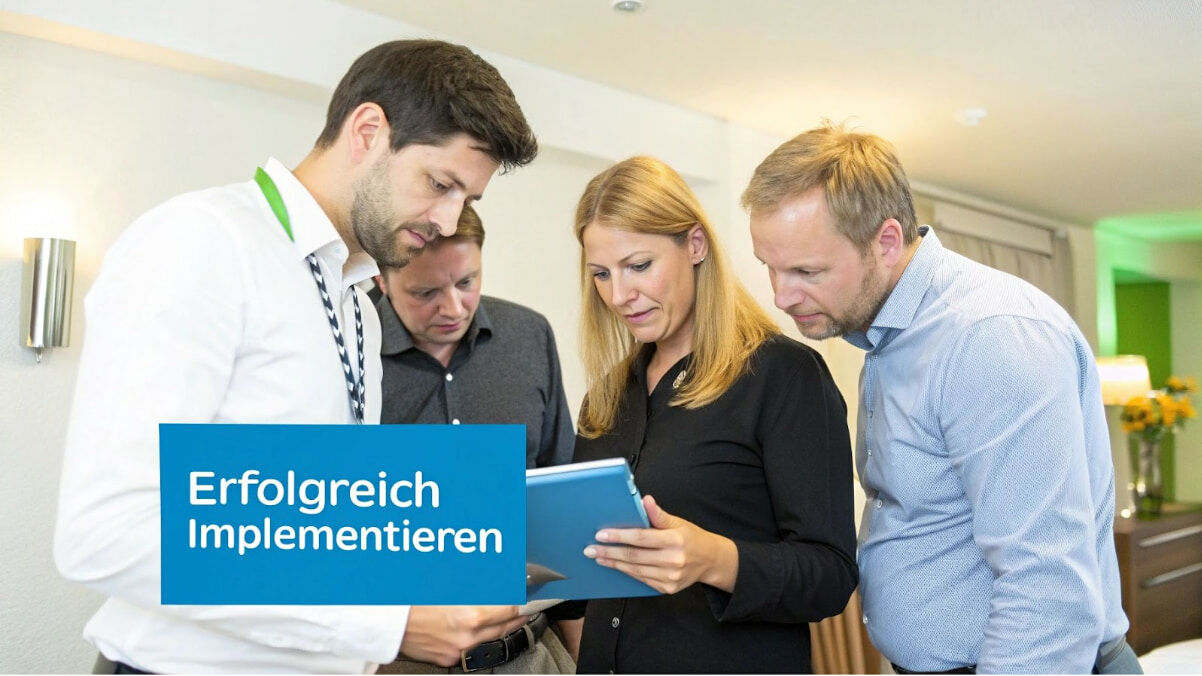
The best software is useless if the implementation fails in day-to-day hotel operations. A well-planned implementation and migration strategy is therefore the foundation of your success. It determines whether the new solution will provide relief from day one – or chaos. For you, this means: The transition is a critical phase that should not be taken lightly. It is not only about overcoming technical challenges, but also about addressing human factors and bringing your team on board from the very beginning.
Your Checklist for a Smooth Transition
A structured process removes the fear from switching systems. This is how you stay in control:
- 1 Carefully plan data migration: Define exactly which data (guest profiles, booking history) must be transferred from the old system. Cleaning the data before migration is extremely valuable.
- 2 Set up a test environment: Insist on a test (sandbox) environment. Your team can safely test the new software here without risking the live operation.
- 3 Conduct targeted staff training: Plan role-specific training. The front desk team needs different training than housekeeping.
- 4 Ensure transparent communication: Inform your team early about the switch. Explain the reasons and the benefits — this creates acceptance.
- 5 Schedule the go-live strategically: Choose a period with lower occupancy for the transition. Plan additional staff resources for the first few days.
Common Mistakes You Should Avoid
Many projects stumble over avoidable errors. If you know these pitfalls, you can proactively prevent them.
Expert Insight: The biggest risk does not lie in the technology, but in the human factor. Poor communication and insufficient training are the most common reasons for failed software implementations. If your team does not understand the benefits or feels overwhelmed, even the best software will not be adopted.
Another critical factor is the service quality of the software provider. An analysis of hotel booking portals shows just how important this is: ehotel.de was rated the portal with the best service at 64.2 percent. This highlights how essential reliability and quick support are. You can find more details in the service quality comparison on de.statista.com.
The Role of the Provider in the Critical Phase
Reliable support from the software provider is essential during the implementation phase. Clarify in advance exactly what level of assistance you can expect:
- ● Availability: Is there a dedicated contact person? What are the support hours – including weekends?
- ● Response time: How quickly are critical inquiries in live operation handled?
- ● Training offering: Does the provider offer practical, helpful training sessions?
A good partner does not leave you on your own after signing the contract but supports you actively throughout the entire process.
Conclusion: Your Checklist for the Final Decision
You have assessed the market and selected your top candidates. Instead of getting lost in feature lists, this checklist helps you examine your options systematically. For you as a hotelier, this is the moment of truth in your hotel software comparison.
Operational and Strategic Key Questions
Evaluate each provider consistently based on the following points:
- ● Practical usability: How many clicks does your reception need for a standard check-in? Request a live demo using your real daily scenarios.
- ● True automation potential: Which manual, time-consuming processes are genuinely eliminated by the software? Ask specifically how automatic confirmations or digital housekeeping planning work.
- ● Future-proof APIs: One of the most important questions. Can you easily integrate a new POS system or marketing tool tomorrow without becoming dependent on the provider?
- ● Quality of support: What happens when things go wrong – on a Saturday evening? Ask about guaranteed response times and whether support is available on weekends.
An often underestimated point: the quality of training. A strong partner ensures with practical training that your team not only knows how to use the system but can fully leverage its potential.
The Final Practical Test
Theory is one thing—practice decides.
- 1 Request a demo: Insist on a personalized walkthrough tailored exactly to your hotel's workflows.
- 2 Use a trial version: Ask for access to a "sandbox" environment so your team can test the software safely.
- 3 Speak with reference customers: Request contacts of hotels of similar size. An honest conversation with peers is often more insightful than any glossy brochure.
With this toolkit, you are perfectly prepared to make a well-founded and strategically smart decision. Trust your analysis and choose the partner that best supports your vision for your hotel.
Are you ready to take the leap toward a modern, integrated solution that automates your operations and boosts revenue? Discover the all-in-one platform from HotelFriend AG and see for yourself how you can optimize your workflow. Request your personal demo now.