
All hotel groups face the same challenge: the system that worked for one property fails when a second, third, or tenth is added. Rates are entered manually, reports are fragmented, and guests are strangers every time. According to a 2026 study of 450 operators by HotelTechReport, 40% rank business intelligence dashboards high and 44% consider CRM and housekeeping integrations critical to daily operations (HotelTechReport).
The market is responding, with the global hospitality PMS market projected to grow from USD 1.73 billion in 2026 to USD 2.44 billion by 2031, with cloud deployment nearing 65% of value (Mordor Intelligence). This guide covers what multi-property management requires, compares the leading PMS and RMS platforms for hotel chains, and explains how to roll out a new system without disrupting properties already running well.
What Challenge Does Multi-Property Management for Chains Solve?
Operating one hotel is not the same as operating ten, but most systems do not differentiate between the two. A platform built for a single front desk starts working against the people trying to scale it. Rates that should update in one place get re-entered property by property, reports that should tell one story get split into ten exports, and guests who deserve to be recognized across the brand end up feeling like strangers at every check-in.
This is precisely the problem multi-property management is intended to address. It’s a design problem. And the friction is silent until it’s stopping the whole group. A portfolio is the unit of management, not a single property with additional locations awkwardly attached, and there is a system in place to close that gap.
Why Single-Property PMS Breaks at Scale
Most property management systems are tailored to a single hotel: one front desk, one set of rates, one team making the call in real time. That works fine for one property, but the cracks appear when a group gets past two or three.
Reservations teams have to log in and out of different systems just to copy the same rate change across all properties. Reporting becomes manual work, pulling numbers from every property and stitching them together for a portfolio view. Guest data suffers too: a guest who's stayed at three properties in the group shows up as three strangers, with no shared history.
But the real problem runs deeper. Single-property systems were never designed to treat property as a growing thing. Corporate oversight, shared inventory, and consolidated financials are added at the last minute, if added at all. Then the gaps compound as the portfolio grows until the system that once seemed efficient starts working against the team.
What Group Operations Actually Need
Managing a portfolio isn't just "single-property management, times ten." It requires an entirely different layer of functionality:
- ● Centralized rate and inventory control: the ability to set pricing strategy at the corporate level while still allowing local flexibility for property-specific demand.
- ● Consolidated reporting: instant insight into performance across the whole portfolio without having to export and reconcile data manually.
- ● Unified guest profiles: a single guest record that follows someone across every property they stay at, enabling real personalization and loyalty tracking.
- ● Role-based access: corporate teams need portfolio-wide visibility. Property-level staff need focused access to their own operations, without wading through data that isn’t theirs.
- ● Cross-property distribution: one connection to OTAs and channel managers that pushes updates everywhere at once, instead of duplicating the work per property.
In short, group operations require a system built around the portfolio as the primary unit, not a single property with extra properties awkwardly appended.
Central Management of Multiple Hotels
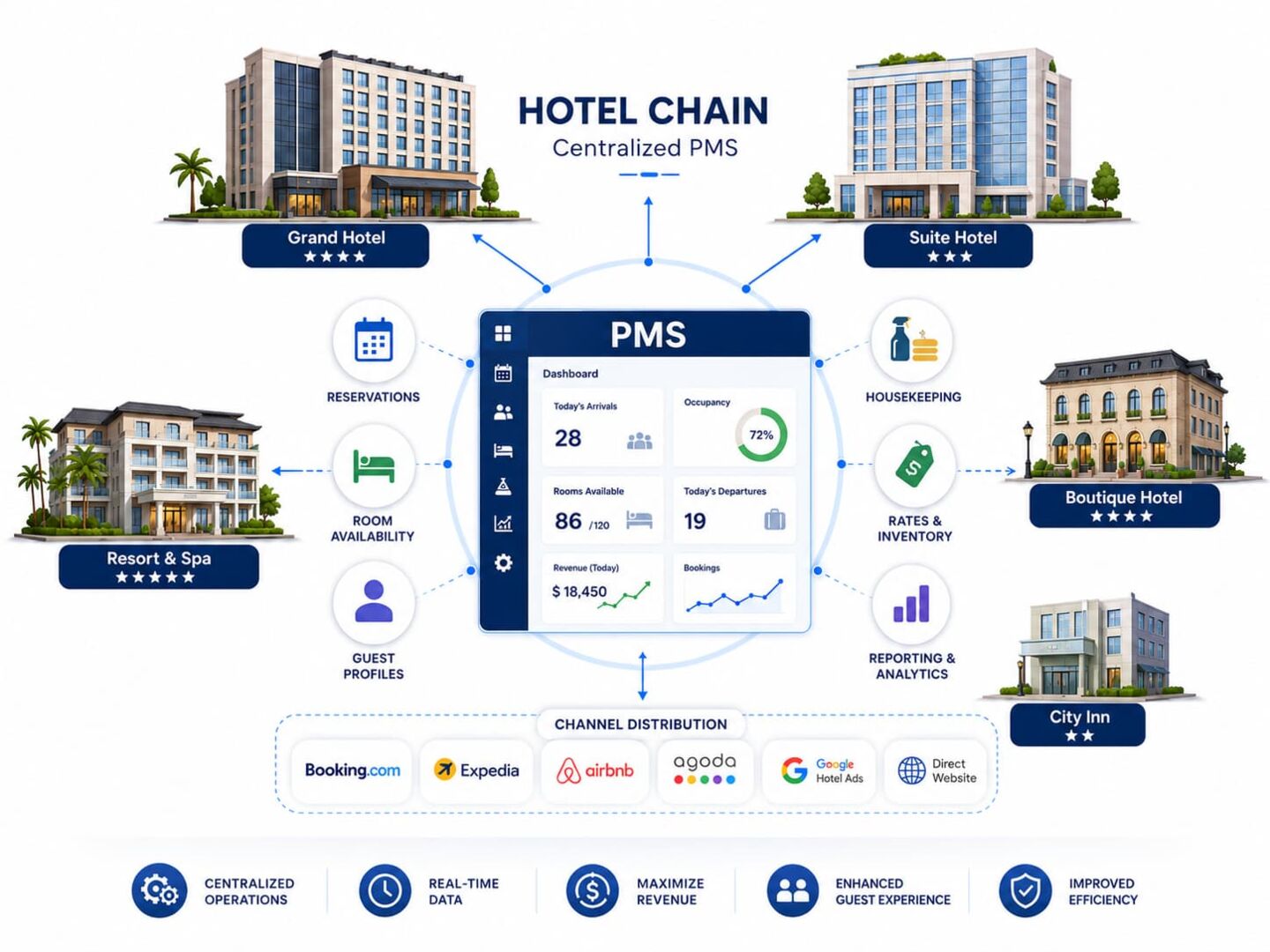
Managing multiple hotels shouldn't mean running multiple systems. Central management brings rates, availability, guest data, and reporting into one place, so corporate teams get a single source of truth while each property keeps the flexibility to run its own operations well.
How to Centrally Manage 3 Hotels?
Once a group reaches three properties, doing things manually stops being an option and starts being a liability. Here's how to bring them under central management, step by step.
- Centralize rate and inventory control. Manage pricing strategy across all three properties from one location, while still allowing individual property managers to adjust for local demand, events or seasonality.
- Build a shared calendar view. Corporate teams have a single screen to view occupancy and availability across all three hotels at once instead of hopping between three separate dashboards.
- Unify guest profiles. Make sure a guest's history travels with them. If someone stays at Property A in March and Property B in June, the front desk at Property B should know that history the moment they check in.
- Centralize distribution. Connect all three properties to OTAs and channel managers through one system. Rate and availability updates then push everywhere at once, instead of being entered three separate times by three separate teams.
- Keep property-level flexibility intact. The goal is not to take autonomy away from properties. That gives corporate teams a single source of truth while property staff can still run day-to-day operations well.
The HotelFriend Experience
"In our experience rolling out HotelFriend Signature across hotel groups, the biggest pain point for front desk teams is always manual duplication of bookings between OTAs and the internal ledger. Once the channel manager takes that over, reception stops firefighting overbookings and can focus on guests instead of screens." - shared by the HotelFriend software development team:
Centralized Reporting & Decision-Making
Effectively managing 3 hotels means quick answers to simple questions: which property is winning, where occupancy is soft, and what needs attention this week. This cannot be done in 3 spreadsheets. Centralised reporting puts revenue, occupancy, ADR and RevPAR side by side, in real time, so teams can see a dip and act on it immediately, rather than reacting weeks later.
This visibility enables comparison also. Executives can determine who their best performer is, which property is lagging, and what strategies are worth replicating in other properties. The emphasis changes from racing to collect numbers to actually analysing what those numbers mean.
Multi-Property Management Systems Compared
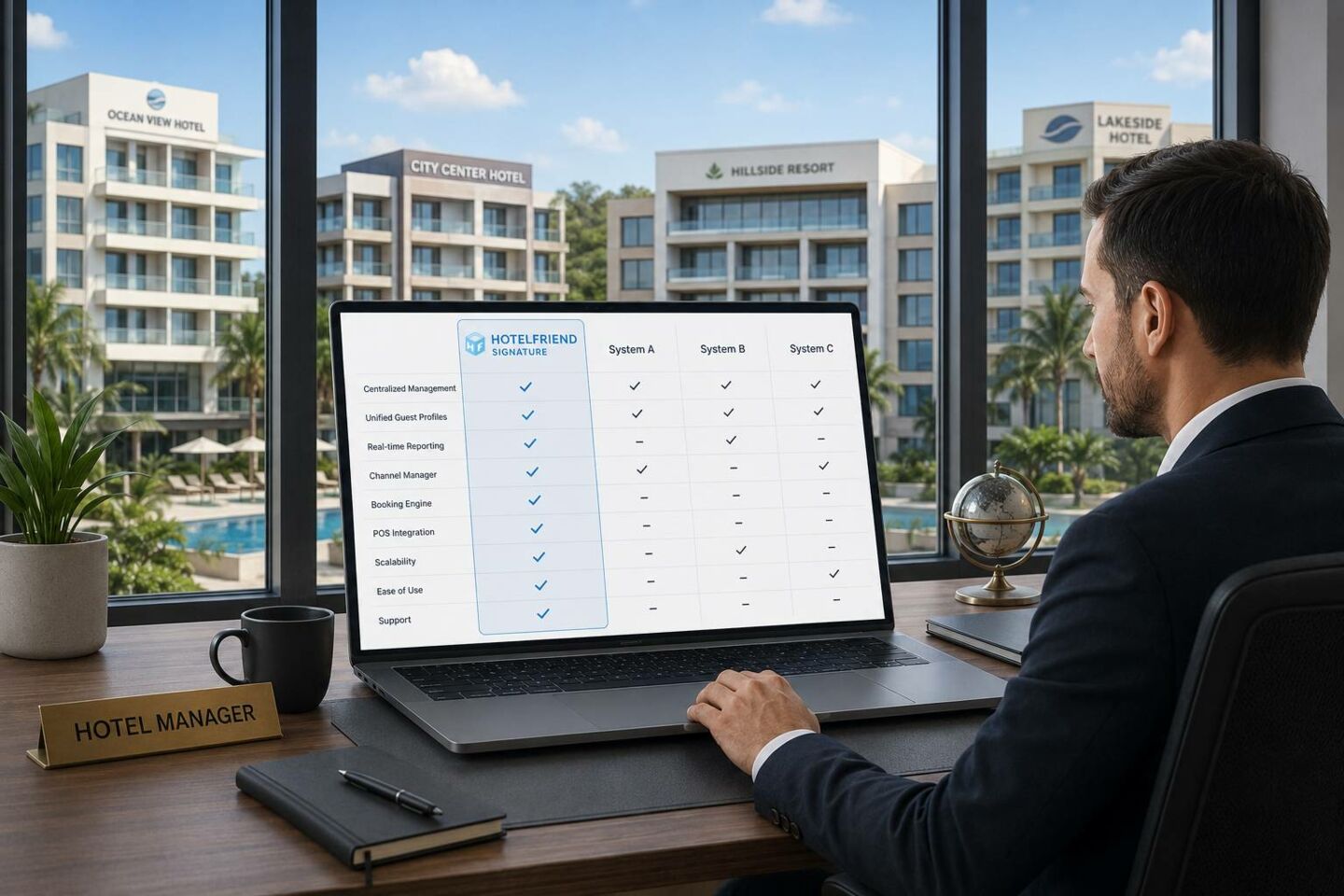
Running a single hotel is one thing. Running a chain is another. As hotel groups expand across locations, the tools that once worked for a standalone property quickly become a liability. A single-property PMS or a legacy system patched with multi-property add-ons wasn't built for the complexity of managing rates, inventory, guest data, and reporting across multiple locations at once.
Hotel chains need a system built for portfolio-wide control: centralised dashboards, unified guest profiles, real-time reporting and the ability to scale without the complexity. The comparison below examines five of the leading multi-property management platforms and the type of hotel group each is best suited for.
Top Solutions for Hotel Chains
Managing several properties requires more than a standard hotel PMS. The solutions below compare five platforms based on multi-property control, centralized reporting, core capabilities, and the type of hotel group each system suits best.
Top Hotel Management Solutions for Hotel Chains
|
Solution |
Multi-Property Management |
Centralized Data and Reporting |
Key Strengths |
Best Fit |
|
HotelFriend Signature |
Centralized control of hotels, rooms, rates, services, permissions, and availability from one account. |
Unified guest, booking, operational, and financial data across the entire portfolio. |
• Integrated PMS and POS; • Booking engine and channel manager; • Automated payments and invoicing; • Housekeeping and guest services; • Self-service kiosks; • Accounting integrations |
All-in-one hotel chains |
|
Mews |
Cloud-native portfolio management with centralized property groups and tools for adding new locations. |
Group-level dashboards for occupancy, revenue, reservations, and operational performance. |
• Workflow automation; • Integrated payments; • Open API; • Large integration marketplace; • Scalable property setup |
Tech-focused groups |
|
Cloudbeds |
Centralized management of reservations, inventory, distribution, and direct bookings across multiple properties. |
Consolidated guest profiles and portfolio-wide performance reporting through Cloudbeds Insights. |
• User-friendly interface; • Integrated channel manager; • Direct booking engine; • Revenue management tools; • Payments and guest engagement |
Independent hotel groups |
|
Oracle OPERA Cloud |
Enterprise-level chain, hub, and property management with detailed permissions and configuration options. |
Centralized profiles, reservations, sales data, events, and reporting across authorized properties. |
• Central reservation system; • Detailed access controls; • Enterprise reporting; • Sales and event management; • Extensive integrations |
Large global chains |
|
Hotelogix |
Single-login control over bookings, availability, rates, guest profiles, and OTA inventory across properties. |
Real-time group reporting for occupancy, revenue, RevPAR, bookings, and property performance. |
• Cloud-based PMS; • Integrated POS; • Channel manager; • Booking engine; • Revenue and performance analytics |
Growing mid-sized groups |
(Information is taken from open sources. Valid as of July 2026)
Case Study: Tiny Hygge Centralizes Multi-Resort Operations with HotelFriend Signature
Client: Tiny Hygge, an eco-friendly tiny house vacation rental operator with properties in Kegnæs and Loddenhøj, Denmark
Property type: Eco-friendly tiny house vacation rentals across multiple locations in Denmark
Challenge
Tiny Hygge's resorts have earned a place on TIME Magazine's "World's Greatest Places 2025" list, but behind the scenes, the operation was far more complex than the cozy guest experience suggested. The company managed multiple resorts across different locations, each with its own set of owners or managers who needed access to key data, while the remote, natural settings of the properties made centralized check-ins and coordination more difficult than usual.
Guests booking through the company’s website, Booking.com and Airbnb, often expected instant confirmation, and payments needed to be centralised whether the guest paid online, by card on site or eventually through an on-property kiosk. On top of that, the company's accountant required seamless DATEV integration for bookkeeping and tax reporting across its German and Danish operations. A standard single-property booking tool simply wasn't built to hold all of that together.
Solution
Tiny Hygge implemented the HotelFriend Signature package, gaining a fully integrated set of tools within a single platform after testing the system through a free trial.
The rollout focused on a few key modules:
- ● A Task Manager that automatically assigns and tracks daily responsibilities, from check-ins to maintenance, giving head office and on-site managers visibility into task completion across locations even when managed remotely.
- ● Real-time housekeeping status, with cleanings scheduled automatically based on bookings and instant status updates once a tiny house is ready.
- ● Built-in Accounting and Cash Book modules that track both digital and cash transactions for each resort individually, keeping financial records organized across properties and owners.
- ● Advanced reporting giving the team real-time visibility into occupancy, revenue, and guest preferences to forecast demand and fine-tune pricing across locations.
A custom-built Multi-Booking Engine lets guests browse all Tiny Hygge locations in a single interface and book directly from one page with real-time availability, while the PMS was connected to both Booking.com and Airbnb so availability syncs automatically across every channel. Tiny Hygge also received a dedicated support manager, individual property profile setup, and several hours of remote staff training as part of the rollout.
Results
Today, Tiny Hygge controls all its locations from one dashboard, having full control over bookings, staff access and property-specific data, without the need for separate tools or duplicate entries. Custom roles and permissions give Tiny homeowners secure, property-level visibility into bookings, revenue, and guest information - without affecting other operations.
Automated emails, task reminders, and fast updates have cut staff response times and sped up guest handling across properties by 30%. You can now manage direct bookings, OTA channels, on-site payments and accounting exports from one place, cutting down on third-party apps and reporting errors.
Feature Matrix
Here is a comparison of basic features of a single property PMS vs. a legacy system with multiple property add-ons. It shows how each option approaches centralised management, reporting, guest data, distribution, access control, and portfolio growth.
PMS Feature Comparison
|
Feature |
Single-Property PMS |
Legacy Multi-Property Add-On |
|
Centralized rate and inventory control |
❌ |
⚠️ Limited |
|
Unified guest profiles across properties |
❌ |
⚠️ Partial |
|
Real-time portfolio-wide reporting |
❌ |
⚠️ Manual exports required |
|
Direct OTA & Channel Manager connection |
❌ |
⚠️ Per-property setup |
|
Role-based access for corporate and property teams |
❌ |
⚠️ Basic |
|
Built-in booking engine and guest services |
❌ |
⚠️ Add-on required |
|
Scalability beyond five properties without added complexity |
❌ |
⚠️ Depends on the setup |

What Is the Best PMS for Hotel Chains?
Choosing the best PMS for a hotel chain isn't the same as choosing one for a single property. The right system needs to handle multiple locations, consolidate data across the portfolio, and give corporate teams visibility without stripping control from individual properties. Here's a closer look at which solutions deliver on that and how to think about picking one based on the size of your group.
Enterprise vs Mid-Market Picks
The right PMS is often dependent on the size and complexity of your portfolio.
For large global chains, HotelFriend Signature and Oracle OPERA Cloud are the standout enterprise picks. Oracle OPERA Cloud offers detailed access controls, sales and event management, and extensive integrations built for organizations juggling dozens or hundreds of properties across regions and teams. HotelFriend Signature scales that level with centralised control over hotels, rooms, rates and permissions, supported by an integrated PMS and POS, automated payments and integrations with accounting, making it a good fit for chains that want enterprise-level capability without cobbling together different systems.
The HotelFriend Experience
"At HotelFriend, we always recommend setting up automatic payment preauthorization at the payment gateway configuration stage. It's a simple technical detail that's easy to overlook, but it's exactly what protects a hotel from fake bookings and no-shows, without adding extra work for staff." - Ihor Hladchenko, HotelFriend’s CTO.
For mid-sized and growing groups, Hotelogix and Cloudbeds tend to serve this segment better. Hotelogix delivers real-time performance analytics with the simplicity of a single login, sidestepping the complexity of an enterprise-grade system, while Cloudbeds appeals to independent groups looking for an intuitive interface paired with strong direct booking capabilities. Mews, meanwhile, sits somewhere in between, flexible enough to serve chains at different growth stages, with an open API and large integration marketplace that appeal to tech-forward teams wanting a customizable foundation as they scale.
Cloud-Based RMS for Multi-Location Hotels
A PMS handles the day-to-day of running a property, but for hotel chains looking to maximize revenue across every location, a dedicated revenue management system (RMS) is just as critical. Cloud-based RMS platforms give multi-location groups the ability to adjust pricing, forecast demand, and respond to market shifts in real time, all from a single, centralized system.
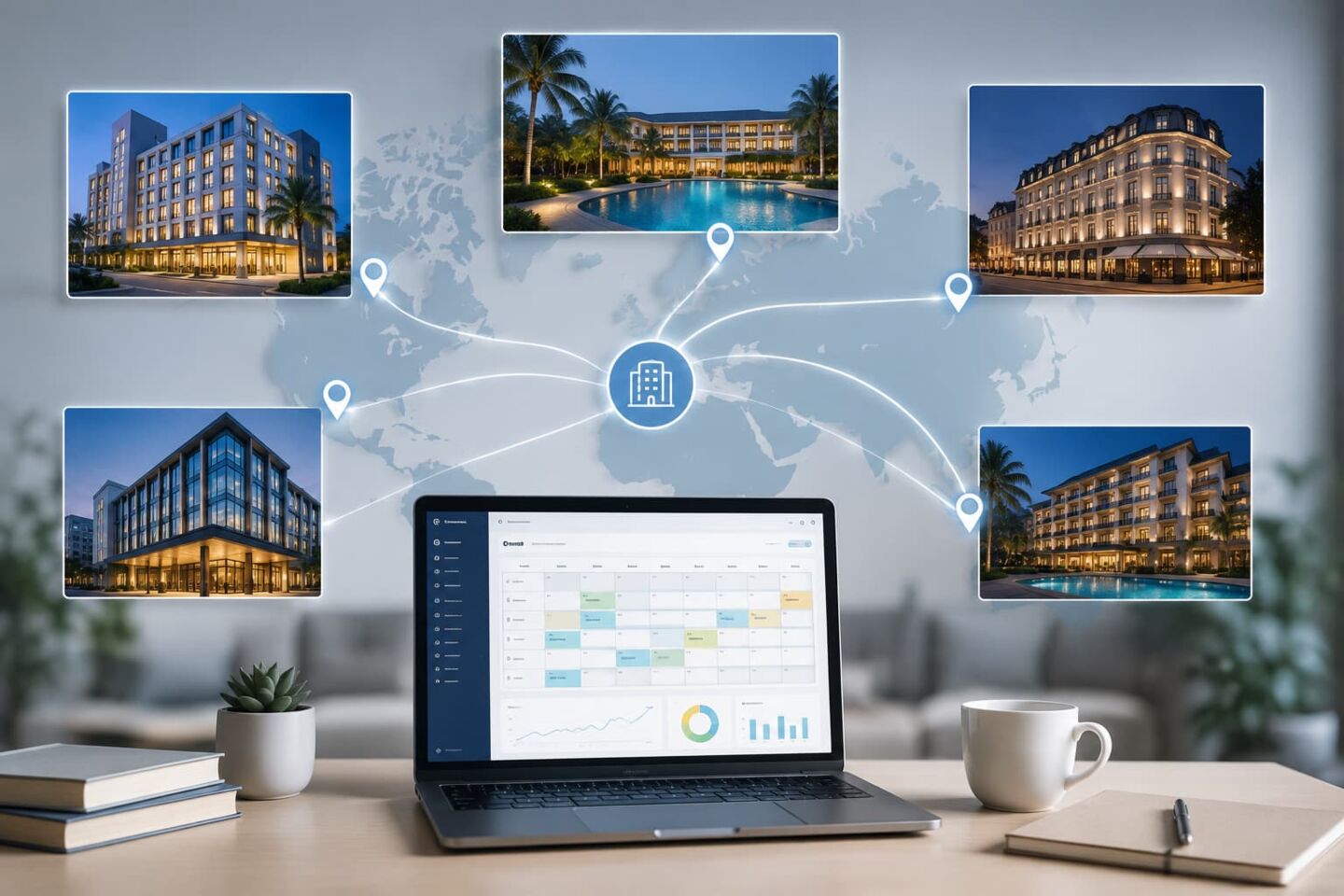
Why Cloud Wins for Chains
Pricing decisions for a hotel chain cannot be made in isolation. The charges on one property influence demand on another, particularly in overlapping markets, so revenue teams require visibility across the entire portfolio, not just one hotel. Cloud-based RMS platforms deliver that visibility and remove the friction that comes with managing pricing property by property.
That’s what a cloud-based RMS can provide multi-location chains:
- ● Portfolio-wide visibility. Pulls data from all properties into one place, allowing corporate teams to identify trends, benchmark performance, and modify strategy without waiting for manual reports.
- ● Instant updates across properties. There’s no need to log in separately or sync manually, since rate changes and adjustments are immediately effective at all connected locations.
- ● Speed across time zones and regions. Pricing can respond quickly to local demand while still aligning with broader portfolio goals, which matters most for chains spread across markets.
- ● Automatic channel sync. Since cloud RMS platforms are natively integrated with a chain’s PMS and channel manager, rate changes are automatically pushed to all OTA and booking channels, minimising rate parity issues and manual errors.
Top Cloud Multi-Site RMS
Not every hotel chain needs the same approach to revenue management. Some are best served by an RMS built directly into their PMS, while others need a dedicated, standalone system for complex, portfolio-wide pricing. The table below compares five leading multi-site RMS solutions, from integrated platforms to enterprise-grade systems, to show how each handles forecasting, pricing, and rate management, and which type of group each suits best.
Cloud RMS for multi-location table
|
Solution |
RMS Type |
Key Revenue Management Features |
Best Fit |
|
HotelFriend Signature |
Integrated PMS and RMS |
• Dynamic pricing; • Demand forecasting; • Centralized rate management; • Performance dashboards; • Channel synchronization |
Hotel chains seeking an all-in-one platform for operations, distribution, and revenue management |
|
Cloudbeds |
Integrated revenue intelligence platform |
• AI-powered demand forecasting; • Competitor rate tracking; • Pricing recommendations; • Portfolio analytics; • Automated rate adjustments |
Independent and growing hotel groups seeking accessible revenue automation within their hospitality platform |
|
Hotelogix |
Integrated PMS and revenue management service |
• Dynamic pricing; • Occupancy forecasting; • RevPAR analysis; • Centralized rate control; • Real-time performance reporting |
Small and mid-sized hotel chains that need integrated revenue tools without enterprise-level complexity |
|
Duetto |
Dedicated cloud RMS |
• Demand forecasting; • Open pricing; • Automated rate recommendations; • Portfolio dashboards; • Group business optimization |
Large or rapidly expanding hotel groups with complex pricing strategies and centralized revenue teams |
|
IDeaS |
Dedicated AI-powered RMS |
• AI-powered forecasting; • Dynamic pricing; • Inventory optimization; • Business-mix analysis; • Multi-property performance insights |
Large hotel chains and enterprise groups requiring advanced forecasting and automated revenue decisions |
(Information is sourced from open sources. Valid as of Jul 2026)
Implementation & Migration Strategy
Picking the right PMS or RMS is only half the battle. There are challenges with rolling it out to a multi-property portfolio, such as data migration, staff training and keeping properties up and running without disruption during the transition. A good plan of action can mean the difference between a smooth rollout and months of operational headaches.
Phased Rollout
Migrating an entire hotel chain to a new system all at once is risky. If it’s going to go wrong, it’s going to go wrong everywhere, and staff at every property are left to troubleshoot a system that's not yet fully understood. A phased rollout significantly reduces that risk and typically includes several critical steps:
- ● Start with a pilot property. Choose one that's representative of the chain's typical operations but small enough that any issues stay contained.
- ● Apply lessons learned before scaling. Once the new system is stable at the pilot site, corporate teams can refine the setup before expanding to a small group of additional properties.
- ● Roll out to the rest of the portfolio in waves. This gives IT and revenue teams time to build standard configurations, integrations and reporting templates that can be duplicated across each new property, rather than reinventing the wheel each time.
- ● Build internal champions. Staff at pilot locations can go on to support training at properties that follow, easing the burden on any single training team and giving new staff peers to turn to rather than just documentation.
Standardizing Across Properties
One of the biggest risks in a multi-property migration is ending up with a dozen slightly different configurations of the same system, each property with its own rate structures, permission settings, and reporting formats. That defeats much of the purpose of moving to a centralized platform in the first place.
Standardizing key elements across properties before rollout begins pays off later. This typically includes:
- ● Rate and room type naming conventions, so portfolio-wide reporting is comparing like with like.
- ● Role-based permission structures that define what corporate teams and individual property staff can see and edit.
- ● Channel manager and OTA connections, set up consistently to avoid rate parity issues across the portfolio.
- ● Reporting templates and KPIs to measure all properties to the same benchmarks.
That said, standardization doesn’t imply rigidity. You may need to be flexible with your pricing strategy or service offerings for properties in different markets or with different types of guests. The goal is a consistent foundation, centralized data, unified reporting, and shared configurations, with enough room for individual properties to adapt to their local market.
Wrapping Up
Managing multiple properties is not a bigger version of managing a single hotel. It’s centralised rate control, unified guest profiles, real-time reporting and distribution that updates everywhere at once. Closing that gap early is what keeps a growing chain efficient instead of overwhelmed. Among the platforms compared here, HotelFriend Signature stands out as the strongest fit for hotel chains that want to run their portfolio on one system rather than stitching several together, bringing PMS, POS, channel manager, booking engine, payments, housekeeping, and accounting into a single account with centralized control over rates and permissions, so fewer systems means fewer places for data to drift out of sync across properties.
It also scales in both directions, holding up for large global chains that need enterprise-level capability while staying flexible enough for smaller, fast-growing operators managing multiple locations. For a chain deciding between a best-of-breed stack or one consolidated platform, HotelFriend Signature makes the strongest case for consolidation, giving corporate teams centralized control without asking individual properties to give up the flexibility to run their own operations well.