
Guests expect hotels to know their preferences and remember them – and many still don’t. Generic communication means booking elsewhere next time. What is hospitality personalization in 2026? What CRM and guest experience tools support it? How do you integrate the PMS, CRM, booking engine, and guest app into one seamless system? This guide has it all broken down for you.
What Is Personalization in Guest Experience?
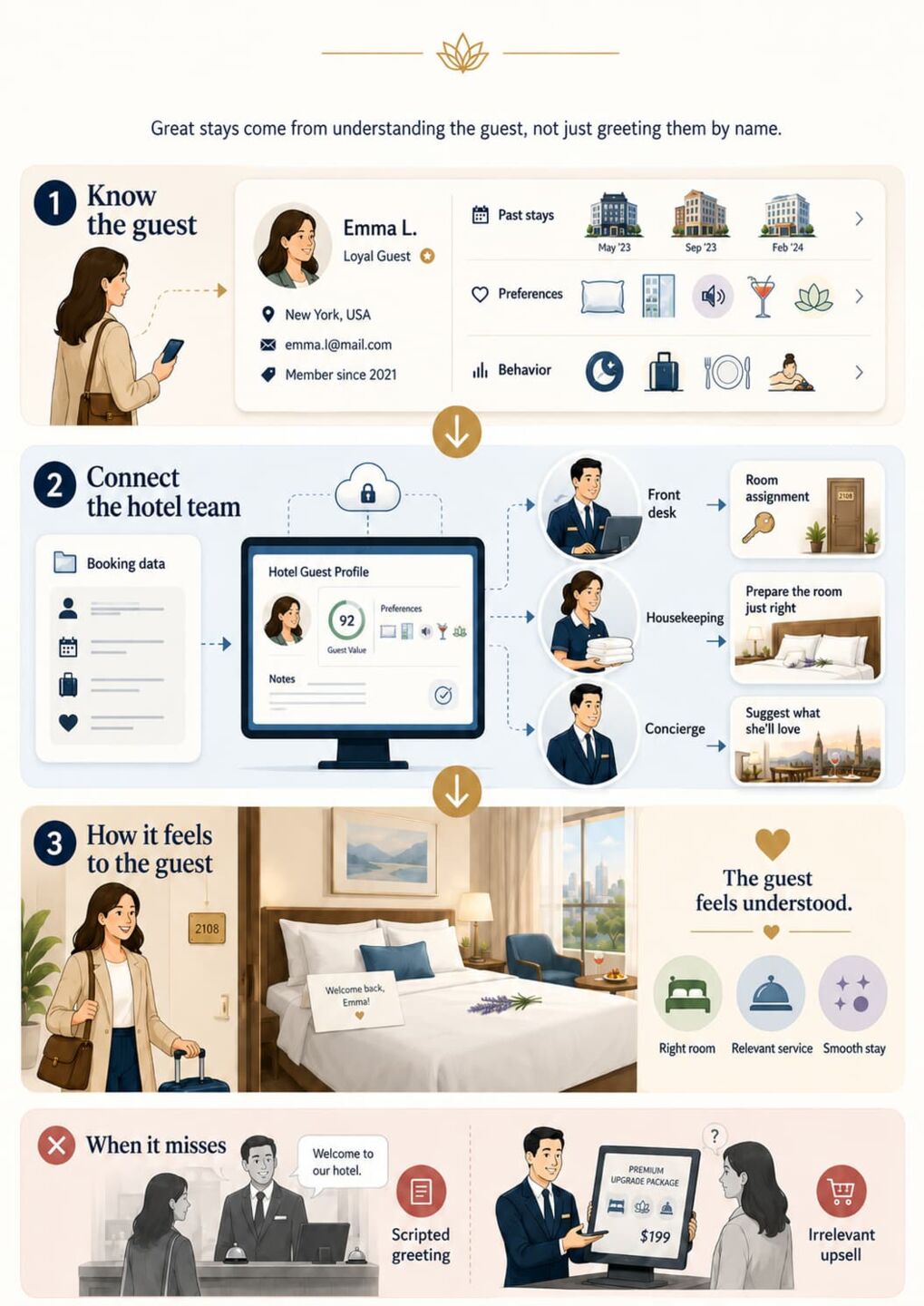
Personalization of the guest experience goes beyond simply addressing a guest by name or sending a birthday email. That is, predicting needs and shaping decisions, from room assignments to staff interactions, based on past stays, preferences, and behavior. It requires connected systems and teams so booking data gets to the front desk, housekeeping, and concierge in a useful way. When it works, it just feels right. When it doesn’t work, it’s a scripted greeting or an irrelevant upsell. The real test is whether the guest feels they are understood.
Why Personalization Drives Revenue
Personalization drives revenue and enables properties to deliver the right offer, at the right time. Instead of blanket promotions, hotels can suggest upgrades, services, or dining options of interest to the guest based on known preferences.
- ● Higher upsell conversion: Relevant offers are more likely to generate a response.
- ● Stronger guest loyalty: Guests who feel understood are more likely to return.
- ● Lower price sensitivity: A better experience can matter more than finding the lowest rate.
- ● More direct bookings: Loyal guests are more likely to book directly.
- ● Lower acquisition costs: No advertising budget required, as new guests come from positive reviews and referrals.
These wins make personalization a viable revenue strategy that supports both immediate spend and long-term guest value.
What Are The Key Phases Of The Guest Journey?
The guest journey is not a single moment. It is a series of connected phases, each offering a different opportunity to personalize the experience and build the relationship. Understanding these phases helps a business know when and how to apply personalization effectively, rather than treating every touchpoint the same way.
What Are The Guest Journey Phases From Booking To Check-Out?
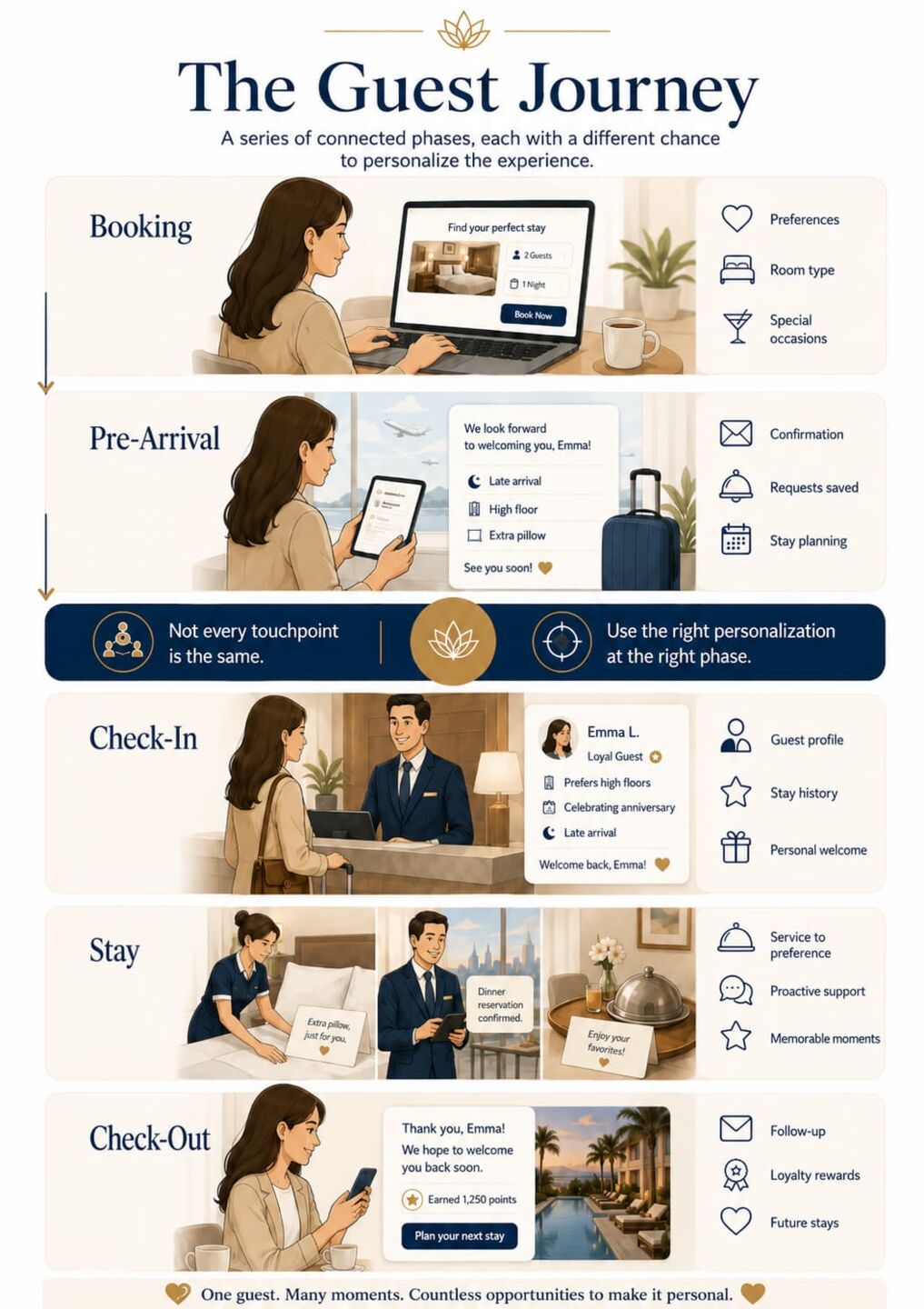
The guest journey comprises five interlinked stages: booking, pre-arrival, check-in, stay, and check-out. There is an opportunity to leverage more of the guest data you already have at each stage. Booking affects the choice of rooms, rates, and add-ons. Pre-arrival communication confirms details and provides relevant upgrades, while known preferences make check-in faster and more personal. Real-time service has the greatest effect on the guest’s feeling during the stay. Then the experience is completed with a seamless check-out and prompt follow-up.
To guests, these stages are one journey. Therefore, personalization needs to be consistent across all the touchpoints.
Booking → Pre-Arrival → Check-In → Stay → Check-Out
These five stages form the core guest journey, with each offering a different opportunity for personalization.
- ● Booking: Recommend rooms, rates, and add-ons using guest preferences.
- ● Pre-arrival: Confirm details, offer relevant upgrades, and brief staff.
- ● Check-in: Create a more tailored arrival.
- ● Stay: Real-time personalization of services.
- ● Check-out: Simplify departure and send relevant follow-ups.
Each stage is built on the prior stage. All five turns are consistent, creating one coherent guest experience of personalized moments.
Touchpoints Where Personalization Pays Off
Some guest touchpoints have a greater effect on satisfaction and revenue than others. Focusing personalization on these moments helps hotels use their data and resources where they can make the biggest difference.
- ● Room assignment: Match guests to known preferences for floor, view, or bed type to increase comfort at no extra cost.
- ● Welcome amenities: Offer a preferred drink, snack, or other small item to create a stronger first impression.
- ● Staff interactions: Provide front desk and service teams with access to guest history to identify returning guests and predict common needs.
- ● Stay recommendations: Recommend dining, spa, or activity to encourage increased spend on past behavior.
- ● Communication: Don’t send blanket promotions; reach out to guests at relevant times in the journey, on their preferred channel.
- ● Problem resolution: Use guest history and loyalty status to respond faster and choose a more appropriate solution.
- ● Check-out and follow-up: Simplify the check-out experience and communicate with the guest after the stay to inspire them to book again.
Effective personalization depends on guest data being available when staff need it, not stored in a system they rarely use.
What Guests Go Through from Booking to Check-Out
Guests don’t need to take separate steps to move from booking to checkout - it’s all one continuous experience. They have expectations at the point of booking. They assess how prepared they feel during pre-arrival. They make a rapid first impression at check-in depending on how seamless it is. It’s the small touches of service and comfort during the stay that matter more than any one gesture, and checkout is the last chance to reinforce a positive impression. Because guests seldom focus on each phase individually, a glitch at one stage can affect their perceptions of the entire experience.
What Is the Best CRM for Hospitality in 2026?
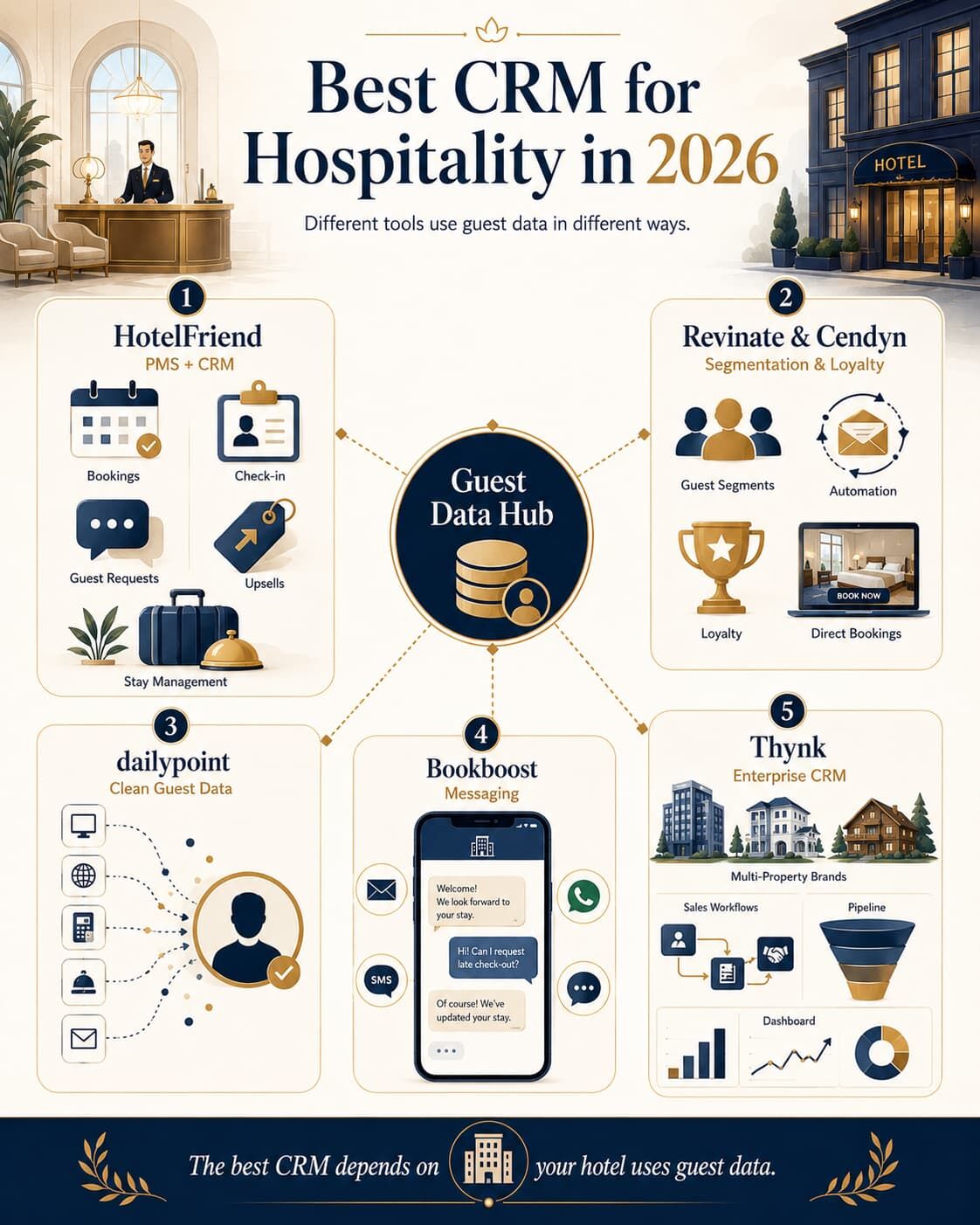
Hotel CRM tools in 2026 differ by how they use guest data. HotelFriend connects CRM features directly with bookings, check-in, requests, upsells, and stay management - all within the PMS. Revinate and Cendyn focus more on segmentation, automation, loyalty, and direct bookings, while dailypoint cleans fragmented guest data and Bookboost adds messaging across email, SMS, and WhatsApp. Salesforce-based tools like Thynk are well-suited to larger brands with more complex CRM and sales workflows.
CRM with Best Guest Profile Features
Guest information, such as personal and contact details, expenses, debts, emails, allergies, meal preferences, and previous orders, is stored in the HotelFriend system. Its PMS page also connects guest profile history with personalized stay details, while the Concierge App keeps guest data synchronized across reservations, messages, requests, and orders.
Top Hospitality CRM Vendors for Guest Profile Management
|
Vendor |
Best Guest Profile Function |
How It Helps Hotels |
Best Fit |
|
HotelFriend |
Operational guest profiles |
Connects guest data with booking, check-in, service, requests, and stay personalization. |
Hotels that want CRM data tied to daily hotel operations. |
|
Cendyn |
Unified guest profiles |
Combines guest data for personalization, direct booking campaigns, and CRM-driven communication. |
Hotel groups focused on marketing, loyalty, and revenue. |
|
Revinate |
Rich guest profiles and segmentation |
Helps hotels use guest data for targeted campaigns, upsells, and repeat-stay communication. |
Hotels that need stronger email marketing and guest segmentation. |
|
dailypoint |
Central guest profile |
Cleans and centralizes guest data so teams can recognize guests and personalize service. |
Hotels with fragmented data across several systems. |
|
Bookboost |
Multi-channel guest profiles |
Merges guest data across touchpoints and supports messaging via email, SMS, and WhatsApp. |
Hotel groups that want CRM, messaging, and automation in one flow. |
(Information is taken from open sources. Valid as of July 2026)
What Is The Best CRM For Hotels With Personalization?
The best hotel CRM brings guest data, preferences, communication, and booking history into one place so teams can personalize service, automate messages, and drive more repeat bookings.
Best CRM Tools for Guest Management & Personalization
|
Vendor |
Best For |
Key Strengths |
|
HotelFriend |
Hotels that want CRM features inside a hotel management platform |
Guest profiles, booking history, direct communication, automation, upsells, and personalized guest service connected with daily hotel operations |
|
Revinate |
Hotels focused on personalized marketing and direct bookings |
Guest profiles, segmentation, email campaigns, loyalty insights, and repeat-stay targeting |
|
Cendyn |
Hotel groups and larger properties |
Centralized guest data, enterprise CRM tools, personalization, and multi-property campaign management |
|
dailypoint |
Hotels with fragmented guest data |
Guest data consolidation, profile deduplication, CRM, loyalty, and data-driven personalization |
|
Bookboost |
Hotels that need CRM plus guest messaging |
Automated guest journeys, messaging, segmentation, upsells, and post-stay communication |
|
Salesforce / Thynk |
Large hospitality brands using Salesforce |
Scalable CRM setup, connected guest data, sales workflows, and personalized guest engagement |
(Information is taken from open sources. Valid as of July 2026)
Best CRM for Bookings + Guest Management
Choosing the right hotel CRM depends on whether a property needs marketing automation, booking-connected guest profiles, or a full system for communication, upselling, and stay management.
Best Hotel CRM Software for Bookings and Guest Management
|
Vendor |
Best For |
Why It Stands Out |
Considerations |
|
HotelFriend |
Best CRM for Bookings + Guest Management |
Connects guest profiles, bookings, check-in, upselling, and stay management within a single system. |
Best fit for hotels that want CRM features inside a broader hotel management system. |
|
Revinate |
Best for Guest Data & Segmentation |
Helps hotels unify guest data, segment audiences, and run targeted campaigns. |
More marketing/data-focused than operations-focused. |
|
Cendyn |
Best for Enterprise Hotel CRM |
Supports guest data, automation, and revenue-focused CRM for larger hotel brands. |
May be too advanced for smaller properties that need a simpler setup. |
|
dailypoint |
Best for Central Guest Profiles |
Turns fragmented hotel data into clean, usable guest profiles. |
Strong for data quality, but may require more setup and integrations. |
|
Bookboost |
Best for Messaging + Direct Bookings |
Combines CRM, guest messaging, and automation to support direct bookings. |
Best for hotels that prioritize guest communication and direct booking campaigns. |
(Information is taken from open sources. Valid as of July 2026)
Centralizing Guest Data
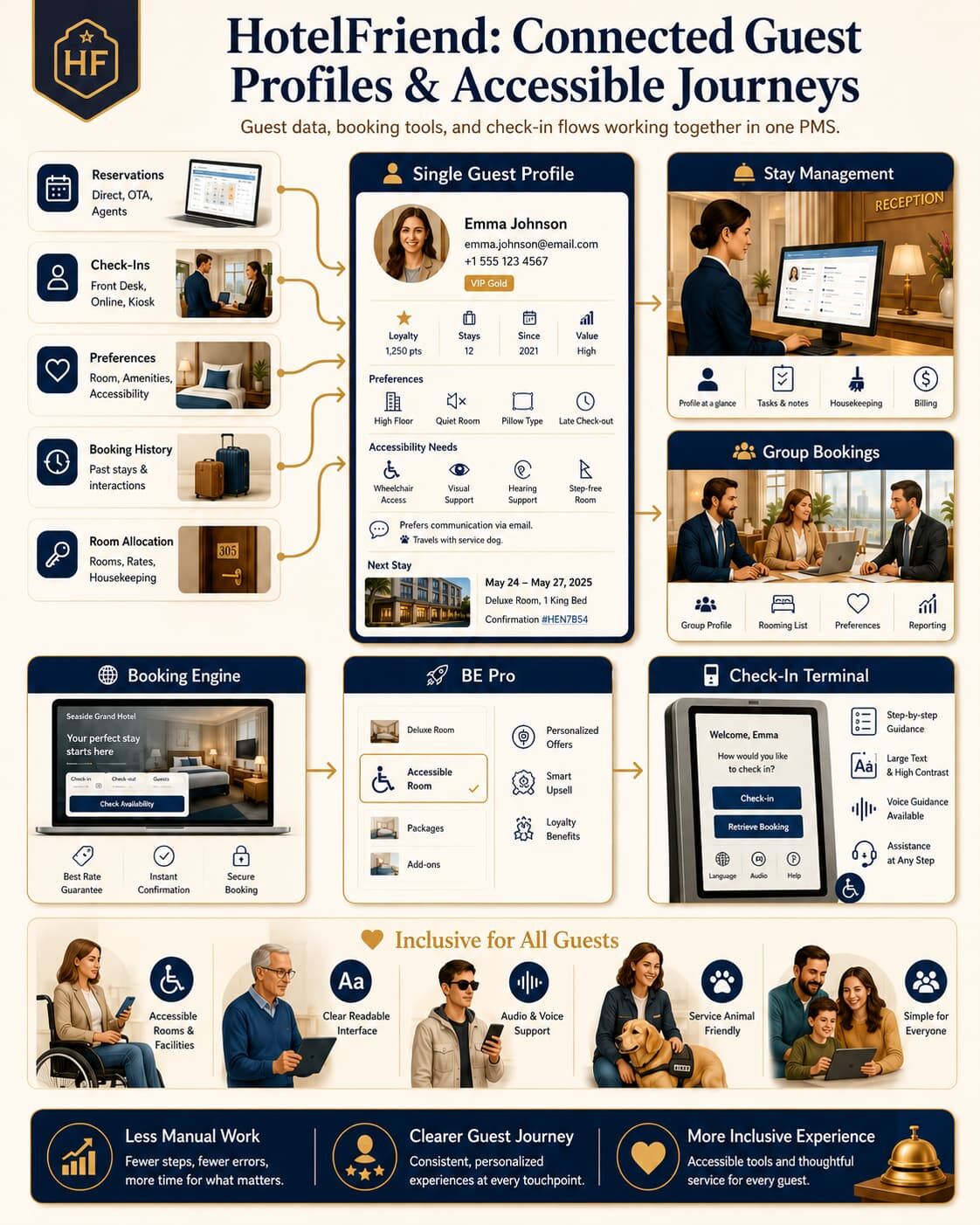
HotelFriend extracts guest data from the PMS and merges reservations, check-ins, preferences, booking history, and room allocation into a single profile. This allows teams to manage stays and group bookings more effectively. Support for assistive technology on the Booking Engine, BE Pro, and check-in terminal helps make booking and check-in more accessible for all guests, including those with disabilities.
When guest data, booking tools and check-in flows are brought together, accessibility becomes part of the hotel’s everyday operations, rather than a standalone process. “We develop these updates at HotelFriend to reduce the amount of manual work for hoteliers and to provide a more transparent, more inclusive and easier-to-complete guest journey for any category of guests.” - Igor Hladchenko, CTO, HotelFriend AG.
How Can A PMS Help With Guest Data Centralization?
The PMS serves as the central database for guest data, including verified stay information such as reservations, check-ins, room assignments, preferences, service requests, payments, and booking history. As the CRM, booking engine, guest app, and other tools sync back into a single profile based on PMS data, hotels can eliminate duplicate records, prevent stale data from creeping in, and provide the same guest context to all teams. This improves the accuracy of communication, upsells, service requests, and post-stay follow-up, and helps returning guests feel recognized throughout their entire journey.
Connecting CRM, PMS & Booking Engine
Hotels usually operate their CRM, PMS, and booking engine as three separate systems, so guest data is entered three times, updated inconsistently, and is rarely the same story twice. Linking the three turns brought together transactions previously siloed into a complete guest profile from booking to checkout.
Get this right and marketing mirrors true guest behavior, front desk staff can see accurate preferences on arrival, and guests receive a consistent experience no matter which channel they booked through.
Legislation Considerations
It’s not enough to be GDPR-compliant to connect the dots between CRM, PMS, and booking engine systems across DACH. Germany, Austria, and Switzerland have similar rules on guest data, consent, retention, and vendor controls, but rules for DPOs, cookies, penalties, and cross-border transfers are different. Below is a table of what hotel groups should look for before syncing guest data across these markets.
DACH Hotel CRM Compliance Comparison
|
Area |
Germany (GDPR + BDSG) |
Austria (GDPR + DSG) |
Switzerland (revFADP) |
|
Legal framework |
GDPR plus BDSG for national additions |
GDPR plus DSG for national additions |
revFADP, separate from GDPR |
|
DPO requirement |
Often mandatory based on staff count processing personal data, with a lower threshold than the GDPR default |
Follows the GDPR’s general threshold and is less prescriptive than Germany |
No formal DPO requirement; advisor role recommended |
|
Cookie / tracking consent |
Governed by TTDSG, with separate consent required for tracking cookies and pixels |
Governed by national ePrivacy implementation, with a similar separate consent requirement |
Less prescriptive than TTDSG |
|
Data processing agreements |
Required under the GDPR standard |
Required under the GDPR standard |
Lighter DPA requirements |
|
Penalties |
Revenue-based corporate fines under GDPR |
Revenue-based corporate fines under GDPR |
Up to CHF 250,000, usually against individuals |
|
Cross-border data transfer |
Not treated as a cross-border transfer within the EU/EEA |
Not treated as a cross-border transfer within the EU/EEA |
Formal cross-border transfer rules apply |
|
Employee data / video surveillance |
Specific BDSG provisions apply, especially if PMS or CRM access overlaps with staff logs |
Specific DSG provisions apply, with similar overlap risks |
Covered by general revFADP principles |
How Does Software For Guest Profiles And Personalization Work?
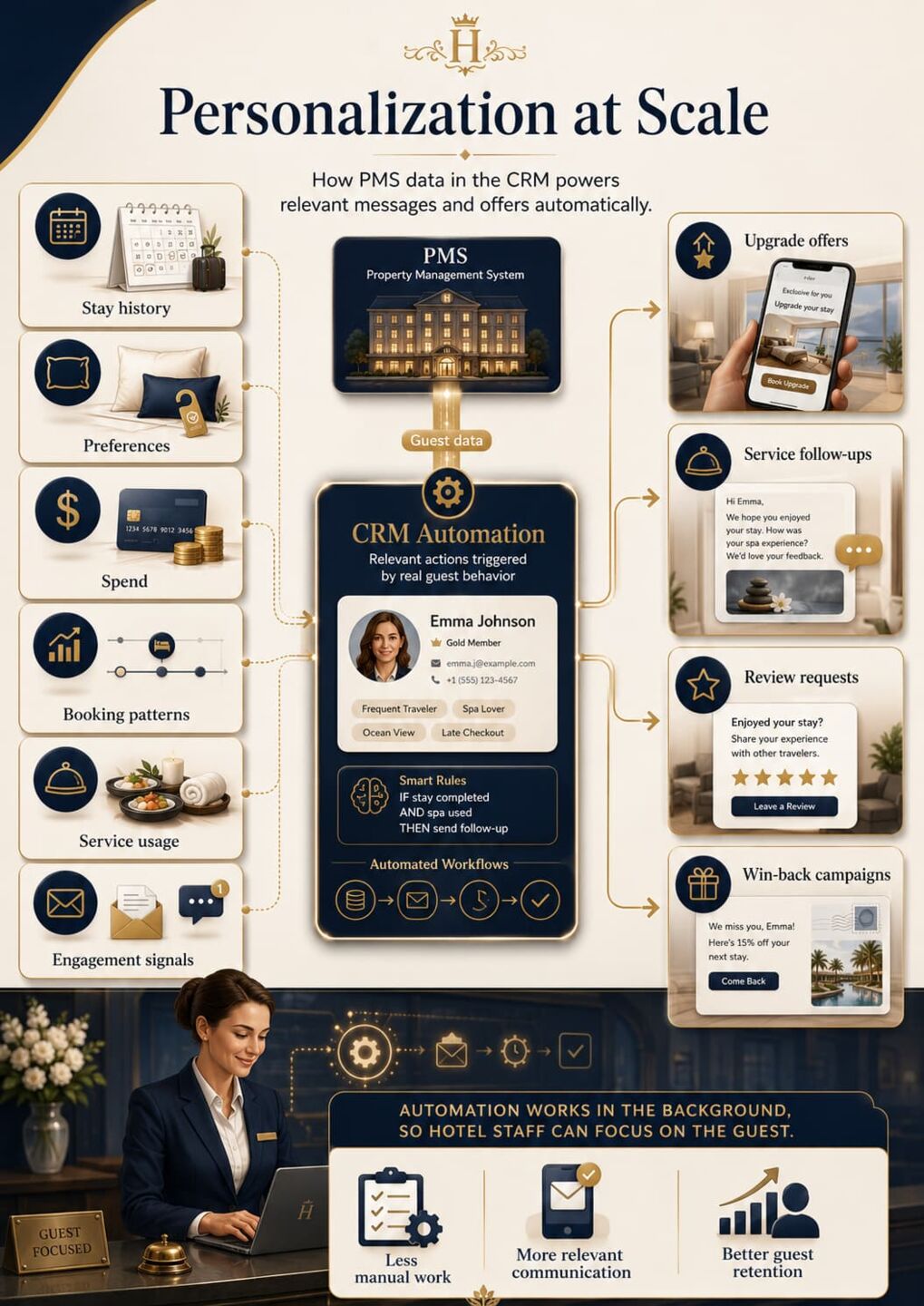
Personalization at scale uses PMS data in the CRM to automate relevant messages and offers based on real guest behavior. Stay history, preferences, spend, booking patterns, service usage, and engagement signals can trigger upgrade offers, service follow-ups, review requests, or win-back campaigns without adding manual work for hotel staff.
Segmentation Logic
Once guest data is centralized in the PMS, segmentation can be based on actual behavior instead of assumptions. Typical criteria are:
- ● Frequency & recency of stay
- ● Spend & rate category
- ● Booking channel
- ● Time of booking
- ● Explicit and implicit preferences
- ● Facilities and use of service
- ● Life-cycle stage
- ● CRM engagements
This enables hotels to send offers relevant to each guest’s history - a premium upgrade for a suite regular, or a timely follow-up for a recent visitor.
Trigger-Based Communications
Rather than pushing messages on a preset schedule, the CRM draws on centralized PMS data to react to what guests are actually doing in real time. That behavioral trigger powers nearly every touchpoint in the stay - confirming a booking before arrival, greeting a guest at check-in, checking in after a spa treatment or dinner charge, asking for a review once the stay ends, reaching out to guests who haven't returned in a while, and marking birthdays or loyalty milestones.
Real guest behavior, not assumptions, drives the system. A new arrival is quickly welcomed, and a voiced complaint can spark automatic recovery outreach. CRM done right is more like caring staff, less like marketing.
Personalized Offers & Upsells
Instead of the same generic offer to every guest, hotels can use centralized guest data to customize upsells based on purchase history, room preferences, purpose of stay, loyalty tier, time, and season.
HotelFriend’s Experience
“Based on our experience at HotelFriend, upsells perform best when they appear naturally in the booking flow or pre-arrival journey. This aligns with guest expectations: Medallia research found that 61% of consumers are willing to pay more for customized experiences, while only 23% report high levels of personalization after recent hotel stays.” – Igor Hladchenko, CTO, HotelFriend AG.
Loyal guests who tend to book higher-category rooms can be offered an upgrade before they even ask. Leisure guests can be offered spa, dining, or local packages tailored to the season and reason for their stay. This makes the offer seem helpful rather than intrusive. The HotelFriend platform allows hoteliers to merge guest data, booking behavior, and upsell offers in a flow. With no extra manual labor, teams can deploy bespoke packages, get more value from every reservation, and make the guest feel as if the hotel knows they’re coming.
Guest Apps & Digital Guest Books
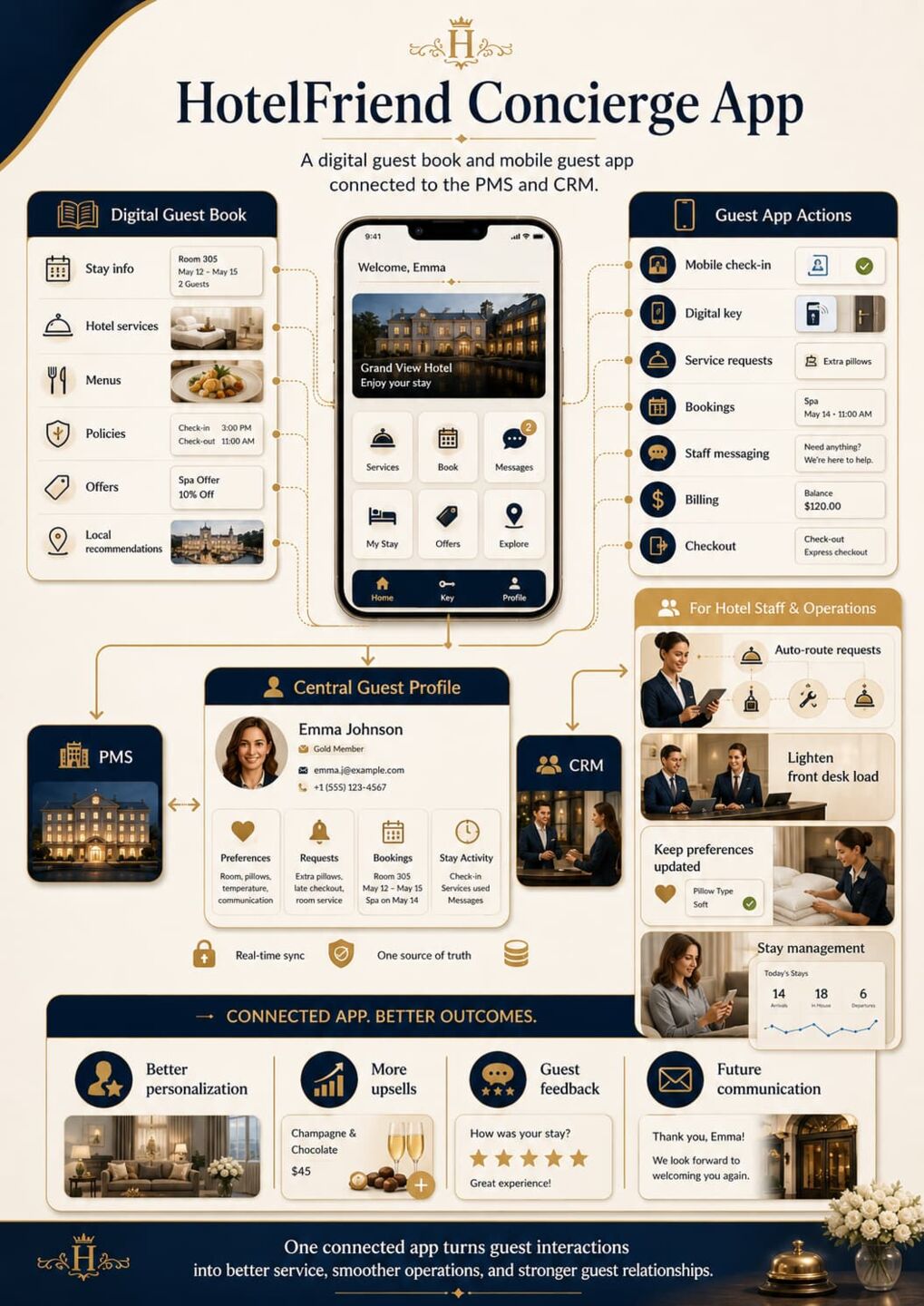
Guest apps and digital guest books are most useful when they integrate directly with the PMS and CRM and not when they are just standalone digital directories. HotelFriend’s Concierge App provides both layers. Guests can access stay-specific information, hotel services, menus, policies, offers and local recommendations in the digital guest book. The app allows guests to act on this information by mobile check-in, digital keys, service requests, bookings, staff messaging, billing and checkout. Every action is linked to the core guest profile, so hotels can automatically route requests, lighten the load on the front desk, keep preferences updated, and transform app interactions into better personalization, upsells, feedback, and future communication.
What Are Apps For Digital Guest Folders?
Digital guest folders replace the paper in-room compendium with an app or web hub connected to the PMS and CRM. They show stay-specific information, services, offers, and messages based on each guest’s booking, preferences, and behavior, while feeding useful data back into hotel workflows.
Digital Guest Folder Features and Hotel Benefits
|
Feature |
How It Works |
Hotel Benefit |
|
Digital check-in and checkout |
Syncs with PMS reservation data so guests can complete arrival or departure online. |
Reduces front desk queues and manual work. |
|
Personalized welcome content |
Uses stay details, room information, and preferences to show relevant guest information. |
Makes the arrival experience more tailored. |
|
In-app service requests |
Lets guests request housekeeping, room service, maintenance, or amenities from the app. |
Sends requests directly into hotel workflows. |
|
Upsells and offers |
Displays upgrades, spa credits, dining packages, or add-ons based on guest segments. |
Increases ancillary revenue with more relevant offers. |
|
Local recommendations |
Shows concierge content, local tips, and seasonal suggestions. |
Improves the guest experience without adding front desk workload. |
|
Real-time messaging |
Allows guests to contact staff through the app or web hub. |
Speeds up communication and reduces the need for lobby visits or phone calls. |
|
Feedback and review prompts |
Triggers surveys or review requests after a stay or service interaction. |
Feeds service insights back into the CRM. |
|
Multi-property consistency |
Gives guests a similar digital experience across properties while keeping local content unique. |
Helps hotel groups standardize service. |
What Functions Should A Good Guest App Have?
A good guest app goes beyond digitizing the paper directory. It acts as a live extension of the centralized guest profile, reflecting what a specific guest needs while feeding data back into the PMS and CRM. Key features include:
- ● Mobile check-in/checkout and digital key, synced with PMS reservation status
- ● Personalized dashboard with info and preferences of stay
- ● In-app service requests logged directly into the PMS
- ● Real-time staff messaging - no phone calls or lobby trips
- ● Personalized offers surfaced from guest segmentation, not generic promos
- ● Digital folio for viewing charges and settling payment in-app
- ● Local guide content tailored to season or stay purpose
- ● Multi-property support with consistent, property-specific content
- ● Post-stay feedback feeding directly into the CRM
- ● Multilingual support and offline reliability for core functions like the room key
The best guest apps are not about feature count but how well they connect to centralized data. Any requests and preferences need to be traced back to the same profile that drives segmentation, offers, and communication elsewhere.
Improving Hotel Experience via App: HotelFriend’s Case
HotelFriend’s PMS has a built-in Concierge App that enables remote check-in, digital key access, in-app service requests, and mobile check-out based on real reservation and guest data, not guesswork, with orders automatically routed to staff. As one of HotelFriend's software engineers explains: "We didn't build the app as a bolt-on - it runs on the same data layer as the PMS itself, so when a guest opens their digital key or requests a service, the system isn't guessing about the reservation, it's pulling the live record. This is what enables checkout to settle on its own and requests to reach staff without anyone touching a terminal."
The result? Hotels using this type of integrated app have reported a 2.5x increase in referral revenue and over a 50% increase in marketing ROI. Making the app from a convenience feature to a direct driver of guest satisfaction and revenue.
How Technology Improves Guest Experience
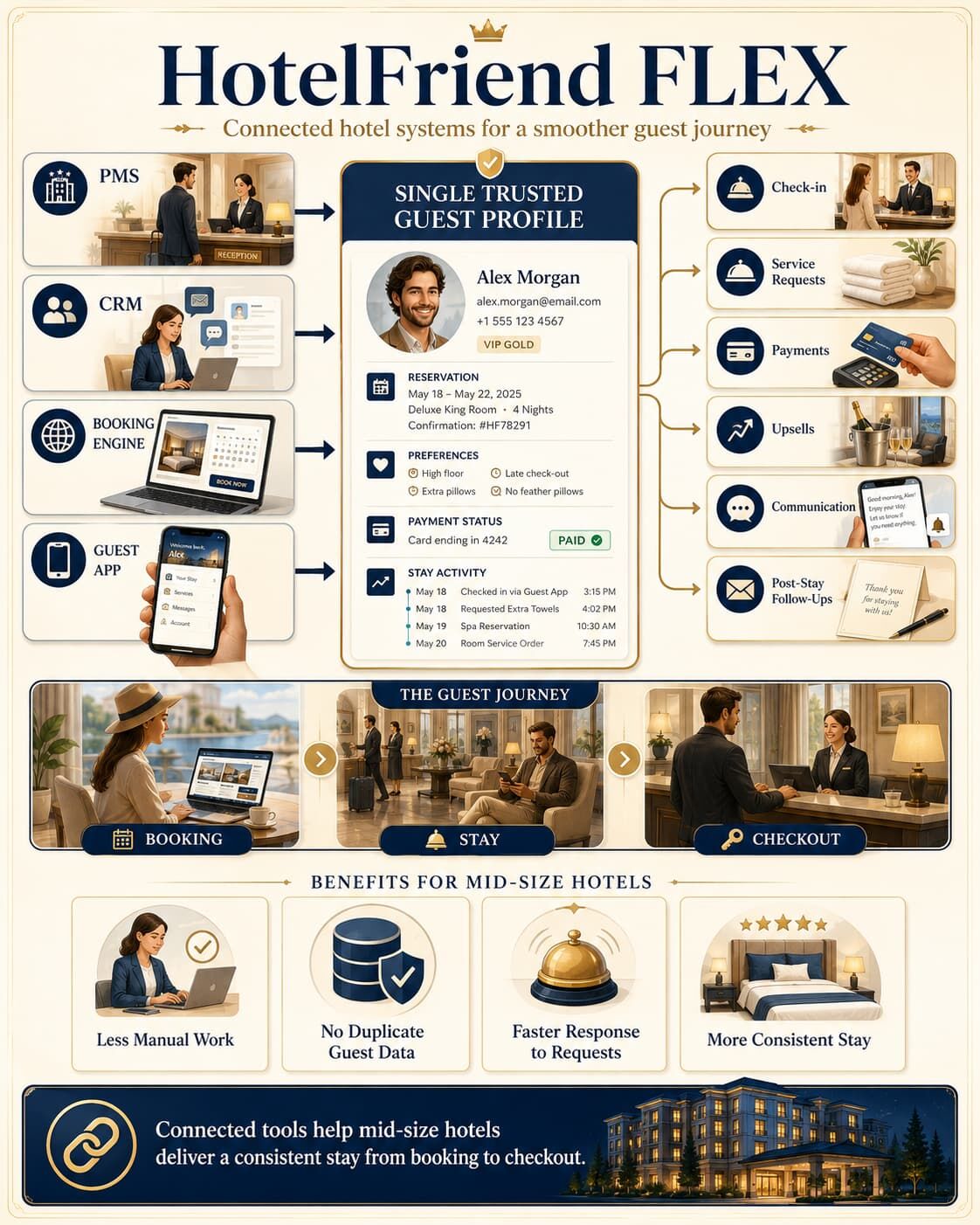
Hotel systems can integrate to enhance the guest experience, not just be isolated touch points. Integration of PMS, CRM, booking engine, and guest app can help hotels create a single trusted guest profile to be used at check-in, for service requests, payments, upsells, communication, and post-stay follow-ups.
HotelFriend FLEX is designed to do this by connecting guest-facing tools with reservations, payments, booking workflows, and daily operations so mid-size hotels can cut down on manual work, prevent duplicate guest data, respond faster to requests, and deliver a more consistent stay from booking to checkout.
How Can Hotels Integrate Tech To Improve Guest Experience?
A tech integration strategy that ties the PMS, CRM, booking engine, and guest app together into one reliable system. First, it establishes the PMS as the single source of truth by mapping data flows and replacing manual exports with two-way, API-based integrations.
Hotels need to ensure that guest identities are consistent everywhere, remove duplicate guest profiles, have clear rules on who owns the data and how to resolve conflicts, and comply with GDPR, BDSG, DSG and revFADP. It must be scalable, so we can add new tools without having to rebuild the whole thing.
Integrations need to be tested in real operating conditions and monitored after launch. Clear internal ownership helps to find sync failures early and keeps the system reliable as the hotel grows.
How Do Mid-Size Hotel Guest Experience Software Options Compare?
Mid-size hotels need guest experience software that improves check-in, communication, service requests, upsells, and guest information without becoming another disconnected tool.
Mid-Size Hotel Guest Experience Software Comparison
|
Vendor |
Best For |
Key Strengths |
Considerations |
|
HotelFriend FLEX |
PMS-based guest experience |
Connects guest tools with reservations, payments, booking engine, and operations. |
Best when the guest experience stays tied to daily workflows. |
|
SuitePad |
In-room tablets |
Digital guest directory, service booking, hotel phone, and in-room communication. |
Best for tablet-based guest engagement. |
|
Duve |
Web guest app |
Online check-in, upsells, messaging, and branded guest journeys. |
PMS depth depends on integrations. |
|
STAY |
Branded guest app |
Hotel services, facilities, destination content, and guest communication. |
Best for mobile service discovery. |
|
DigitalGuest |
Digital guest directory |
White-labeled directory, QR access, segmented content, upsells, and upgrades. |
Good for content and offers without PMS replacement. |
|
Bookboost |
CRM + messaging |
Guest web app, CRM, automation, feedback, and guest communication. |
Stronger for messaging than PMS-based operations. |
(Information is taken from open sources. Valid as of July 2026)
How Does A PMS Support Guest Management And Communication?
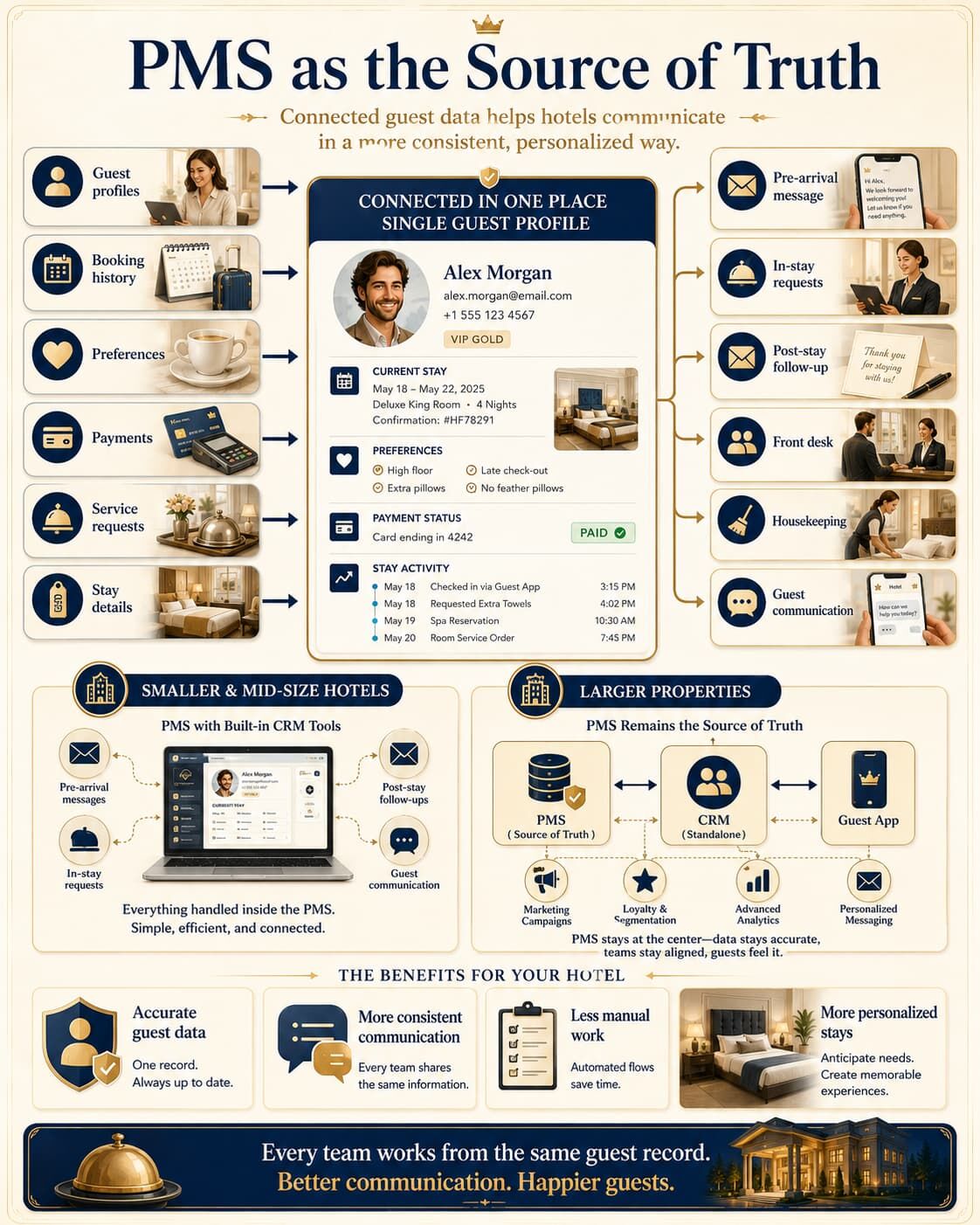
A PMS with guest management and communication features helps hotels keep guest profiles, booking history, preferences, payments, service requests, and stay details connected in one place. For smaller and mid-size hotels, built-in CRM tools can often handle essential messaging, pre-arrival communication, in-stay requests, and post-stay follow-ups. Larger properties may still use a standalone CRM or guest app, but the PMS should remain the source of truth so every team works with accurate guest data and communicates with guests in a more consistent, personalized way.
Built-In CRM vs Standalone
Hotels can either use a CRM that is integrated with the PMS or integrate a separate CRM. Integrated CRMs work well for mid-size hotels that want guest profiles tied to bookings, check-in, requests, payments, and ops. Standalone CRMs offer more powerful marketing and loyalty tools - as long as the PMS and booking engine integrations keep guest data current.
Built-In vs Standalone Hotel CRM Comparison
|
CRM Type |
Best For |
Key Strengths |
Considerations |
|
Built-in CRM |
Operational CRM inside PMS |
Guest profiles, stays, payments, and requests stay connected. |
Simpler to manage, but may offer fewer marketing tools. |
|
Standalone CRM |
Marketing and loyalty |
Advanced segmentation, campaigns, and guest journeys. |
Needs strong PMS and booking engine integrations. |
|
Hybrid setup |
Operations + advanced marketing |
PMS stays the source of truth; CRM handles campaigns. |
Requires clear data ownership and sync rules. |
Recommended Stack Combinations
The right hotel tech stack needs to be suited to the size of the property, the traffic of guests, and the need to communicate. Smaller hotels may only need a basic PMS-based setup, while larger groups may have their own standalone tools for CRM, booking, guest apps, etc. The PMS should be the single source of truth for all configurations, and new tools should only be added when they improve segmentation, personalization, or guest workflows.
Recommended Hotel Tech Stack by Property Type
|
Hotel Type |
Recommended Stack |
Why It Works |
|
Small independent hotels |
PMS + built-in CRM + booking engine + light guest app |
Keeps tools simple, reduces integration work, and avoids unused enterprise features. |
|
Mid-size properties and boutique groups |
PMS + built-in CRM + booking engine + guest app |
Balances daily operations, booking control, in-stay requests, upsells, and marketing growth. |
|
Hotel groups and multi-property portfolios |
PMS + standalone CRM + booking engine + channel manager + synced guest app |
Supports cross-property guest recognition, segmentation, and distribution control. |
|
Luxury and high-touch properties |
PMS + standalone CRM + personalized guest app |
Helps staff use guest preferences, concierge notes, and stay history before arrival. |
|
Budget and limited-service hotels |
PMS + built-in CRM + booking engine + channel manager |
Focuses on reservations, distribution, and clean operations instead of low-use guest app features. |