
Small hotels are adopting PMS platforms to reduce manual work without adding staff. Independent properties held 51.45% of the hospitality PMS market in 2025 (Mordor Intelligence). 89% of hoteliers said their system saved two to ten-plus hours per week (HotelTechReport).
As the market is expected to grow to $2.44 billion by 2031, small hotels need affordable, easy-to-use software rather than complex chain-level systems (Mordor Intelligence). This blog post compares PMS options by price, room count, features, and use case.

Why Small Hotels Need a Different PMS Than Chains
Most property management systems were built with 200-room chain properties in mind: multi-property dashboards, deep OTA integrations, layers of role-based permissions, and revenue management modules designed for teams of specialists. A 12-room boutique hotel doesn't need any of that complexity, and forcing it into that mold usually creates more problems than it solves.
Operational Differences
Small, independent hotels operate on a fundamentally different model from chains, and that shapes what they need from software.
- ● One person wears many hats. The owner might be checking guests in, answering the phone, doing the books, and managing housekeeping schedules, often all before lunch. A PMS built for a front-desk team, a revenue manager, and a separate ops department assumes a division of labor that simply doesn't exist here.
- ● Simplicity beats configurability. Chains value systems that can be endlessly customized across properties and brand standards. Independent owners want something they can learn in an afternoon and never have to think about again.
- ● Guest relationships are personal, not segmented. A small hotel's edge is often personal service and repeat guests who feel remembered. The PMS needs to make it easy to do that with quick notes on preferences and easy communication, not treat each guest as an anonymous row in a CRM.
- ● Fewer rooms, but no less complexity per booking. With only 8 to 20 rooms, occupancy swings hard on individual bookings. Owners need clear, immediate visibility into their calendar rather than aggregate dashboards built for hundreds of rooms.
- ● Minimal IT support. Chains have IT departments to handle integrations and troubleshooting. Independent owners are on their own, so the system has to be reliable and self-explanatory, with support that's actually reachable.
HotelFriend Experience
Having analyzed the operations of more than 200 of our clients, we found that front-desk staff spend up to 40% of their working time manually transferring bookings from Booking.com into an internal log. An automated Channel Manager eliminates this problem entirely, reducing the risk of overbooking to zero.
Which property management software works for a small pension on a budget under €100 a month?
Small hotels often need to balance limited budgets with reliable property management tools. The table below compares five PMS vendors with entry-level plans that fit within a €100 monthly budget, depending on room count, selected features, and additional fees.
Best Management Software Small Budget Table
|
PMS |
Starting Monthly Price |
Main Features |
Best For |
|
HotelFriend Core |
From €30 |
PMS, booking engine, channel manager, housekeeping, guest communication, payments, and reporting in one package |
Small independent hotels that want an affordable all-in-one system |
|
Sirvoy |
From €9; free for one unit |
Reservation management, booking engine, automated guest messages, housekeeping tools, and optional channel management |
Small hotels, B&Bs, and guesthouses that need simple, scalable pricing |
|
Beds24 |
From €15.50 |
Cloud PMS, booking engine, flexible rate management, and optional OTA connections |
Budget-conscious properties that need a highly configurable platform |
|
Smoobu |
From €28 |
PMS, channel manager, booking engine, guest management, automated communication, and booking website |
Guesthouses, aparthotels, and small properties managing several booking channels |
|
Amenitiz |
From €42 |
PMS, booking engine, channel manager, website builder, payment processing, and dynamic pricing tools |
Independent European hotels that want a broader all-in-one platform |
(Information is taken from open sources. Valid as of July 2026)

Top PMS for Small Hotels - Compared
Picking a PMS isn't just about finding the cheapest option. It's about matching the platform to your room count, budget, and the complexity you actually need. Below is a practical comparison across the ranges most independent hotels fall into.
What PMS alternatives exist for a small boutique hotel with only 15 to 20 rooms?
A hotel this size typically needs a lean all-in-one system, bundling PMS, channel manager, and booking engine, without enterprise revenue management tools. Actual pricing may vary depending on room count, selected modules, billing period, integrations, and taxes:
Small Hotel PMS Pricing and Use-Case Comparison
|
PMS |
Pricing Model |
Approx. Monthly Cost for 15–20 Rooms |
Primary Use Case |
Best Fit |
|
HotelFriend Core |
Room-based pricing |
€75–€100 |
Combining daily hotel operations, direct bookings, OTA distribution, housekeeping, payments, and guest communication in one system |
Independent hotels that want an affordable all-in-one PMS |
|
Hoteliga Silver |
Fixed monthly plan |
€50 |
Managing reservations, guest records, room availability, and front-desk operations |
Small hotels that need straightforward PMS functionality at a predictable price |
|
Nobeds Premium |
Fixed monthly plan |
€15 |
Handling reservations, channel distribution, booking engines, rates, and automated guest communication |
Budget-conscious properties that need broad functionality at a low cost |
|
Sirvoy Pro |
Room-based pricing |
From €44 |
Managing direct and OTA bookings, housekeeping schedules, guest profiles, and team access |
Small hotels focused on simple operations and distribution |
|
Beds24 |
Usage-based modular pricing |
Varies by room count, room types, and OTA connections |
Building a customized PMS setup with booking, automation, payments, messaging, and channel connections |
Hotels that need flexible configuration and only want to pay for selected features |
(Information is taken from open sources. Valid as of July 2026)
HotelFriend Core package bundles PMS, booking engine, channel manager, housekeeping, payments, and guest communication into one system starting at €30/month. An independent hotel gets everything it needs without having to manage separate vendors or pay for modules it doesn’t use. Built for owner-operators who wear many hats, with one dashboard to make daily front desk tasks simple, instead of getting lost in chain-level complexity.
By Room Count: 20–50 Rooms
As room count grows, occupancy volatility and channel complexity increase. The systems in this range need stronger channel management and reporting without jumping into full enterprise territory.
Top 5 PMS Systems Price Comparison 20 Rooms Table
|
PMS |
Starting Price |
Scalability Strength |
Best For |
|
HotelFriend Core |
Pricing varies by room count |
Combines PMS, booking engine, channel management, housekeeping, payments, invoicing, and guest communication in one system |
Growing independent hotels that want an affordable all-in-one platform |
|
Cloudbeds |
From approximately $500/month |
Offers broad distribution, integrated payments, automation, reporting, and an extensive partner marketplace |
Hotels expanding their sales channels and adding more integrations |
|
Little Hotelier |
Mid-range pricing |
Provides straightforward reservation, channel, direct booking, and revenue management tools |
Owner-operated hotels that need simple software as room inventory grows |
|
Hotelogix |
~$150–$400 |
Supports advanced front-desk workflows, multi-department operations, reporting, and multi-property management |
Hotels moving from basic reservation software to more structured operations |
|
Mews |
~€200–€500+ |
Provides automation, self-service tools, embedded payments, revenue management, and a large integration marketplace |
Tech-focused boutique hotels planning further growth or expansion |
(Information is taken from open sources. Valid as of July 2026)
What is the best hotel management software for small hotels with a limited budget?
Choosing the right PMS means balancing functionality, ease of use, and long-term scalability. The table below highlights the main strengths and limitations of five popular platforms for small hotels.
Small Hotel PMS: Key Pros and Cons
|
Vendor |
Key Pros |
Key Cons |
|
HotelFriend Core |
• Modular system that lets hotels choose the features they need • Combines PMS, booking engine, channel manager, payments, and guest communication • Scales well for small independent properties |
• Optional modules can increase the total cost • Pricing may rise as the hotel adds rooms and features |
|
Sirvoy |
• Includes essential hotel management tools • Pro plan supports OTA channel management • Suitable for small teams and independent properties |
• Some advanced features are reserved for higher plans • Certain integrations and add-ons may cost extra |
|
Beds24 |
• Combines PMS and channel management tools • Highly flexible and customizable • Supports different property types |
• Modular pricing can be difficult to predict • Extra rooms, channels, users, and services may increase costs • The interface may feel complex for beginners |
|
hoteliga |
• Covers essential PMS functions • Straightforward for properties with a limited number of rooms • Relatively simple to set up and manage |
• Entry plans may limit users and support options • The lowest rate may require annual billing • Less suitable for larger or fast-growing hotels |
|
Smoobu |
• Combines key tools for guesthouses and rental properties • Suitable for properties with only a few units • Supports booking and channel management in one platform |
• Additional units increase the total cost • Some plans include a booking commission |
Sirvoy and hoteliga favor simplicity, Beds24 offers more flexibility, and Smoobu suits guesthouses and rentals. HotelFriend CORE is a better fit for independent hotels seeking a broader, more modular platform, though costs may increase as additional rooms and features are added.
Which hotel software compares small hotel PMS systems that also handle guest communication?
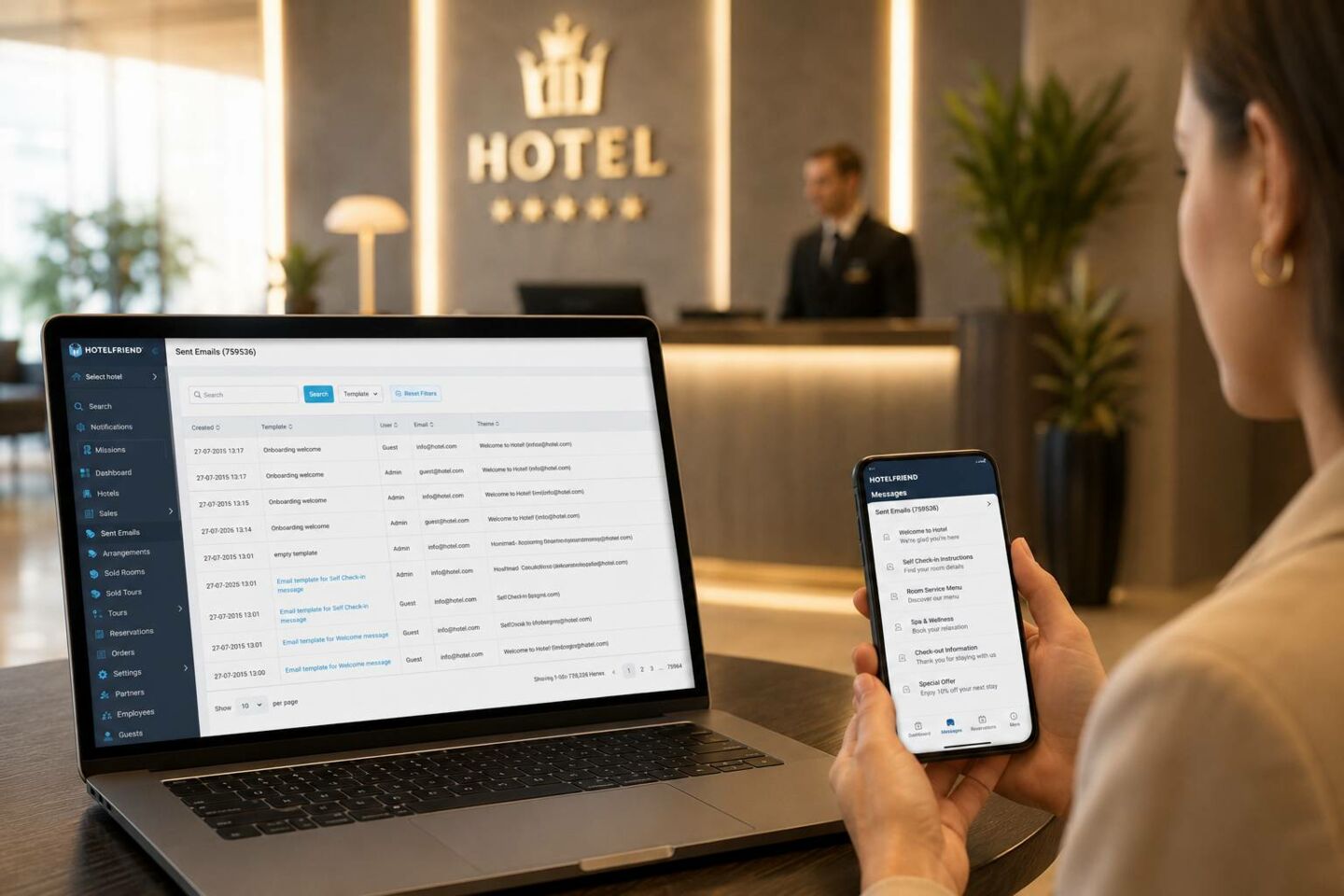
Guest communication has quietly become one of the most important features in a modern PMS. A hotel fielding requests across phone, email, SMS, WhatsApp, and OTA inboxes needs a system that consolidates that traffic, not five separate apps competing for attention. For small hotels specifically, the question isn't just "does it have messaging," but whether that messaging is genuinely built into the PMS or bolted on as a costly third-party add-on.
Combined PMS + Communication Solutions
Some platforms treat guest messaging as a native part of the reservation system, automatically pulling guest names, room numbers, and stay details. Others require pairing your PMS with a separate messaging tool, which adds another vendor relationship and another monthly bill. Here's how the main options stack up.
Hotel PMS Guest Communication Tools: Features and Pricing
|
Vendor |
Communication Approach |
Price Range |
Key Notes |
|
HotelFriend Core |
Native guest communication connected to the core PMS |
From about €30/month; final price depends on rooms, channels, and modules |
Brings reservations, hotel operations, and guest communication into one system. Additional guest-facing modules may affect the final price. |
|
Cloudbeds |
Integrated messaging through Cloudbeds Guest Experience, formerly Whistle |
Custom quote |
Centralizes email, SMS, WhatsApp, and OTA messages, with automated communication and a guest portal. Messaging credits or usage fees may apply to some channels. |
|
Mews |
Native guest journey tools supported by marketplace integrations such as Runnr.ai |
Custom room- or bed-based pricing |
Connects digital check-in and upselling with third-party messaging tools. Runnr.ai is an external integration rather than a standard PMS feature. |
|
Stayntouch |
AI-powered guest messaging embedded in the PMS |
Custom pricing |
Uses reservation data to answer routine questions, centralize conversations, and support upselling throughout the stay. |
|
Little Hotelier |
Native Guest Engagement platform |
Plan-based pricing; quote varies by property |
Provides a shared inbox for email, SMS, WhatsApp, Airbnb, and Booking.com, along with scheduled messages, digital check-in, upselling, and review collection. |
|
Amenitiz |
Automated emails and a unified inbox, with expanded messaging in the Advanced plan |
Quote-based; Advanced may start around $113/month excluding VAT |
Core includes automated emails and OTA messaging. Advanced adds broader guest messaging and WhatsApp tools. |
(Information is taken from open sources. Valid as of July 2026)
Best Hotel Management Software for Small Hotels: Budget Choices
You don’t need enterprise pricing to run small properties efficiently. There are good options for every budget in today’s PMS market, from free plans to premium tools that are still affordable. How to pick by tier.
Small Hotel PMS Pricing Tiers
|
Tier |
Typical Price |
Best For |
|
Free & Trial |
$0 (limited) |
New or very small properties testing the waters |
|
Mid-Tier |
$20–$80/month |
Most small hotels looking for a long-term solution |
|
Premium-but-Affordable |
$80–a few hundred/month |
Growing properties ready to scale |
(Information is taken from open sources. Valid as of July 2026)
Free & Trial Options
Free tiers and trials (usually 14–30 days) are the lowest-risk entry point. They typically include:
- ● Reservations and a booking calendar
- ● Basic guest management
- ● Limited channel connections
Good fit for a single small property, such as a B&B or boutique inn, that avoids double bookings without a monthly fee. Trade-offs include a limited number of user seats and no extras such as housekeeping tools or reporting. Look for an intuitive calendar, basic channel manager integration, and no long-term lock-in.
Mid-Tier Options
This is where most small hotels settle long-term:
- ● Complete booking system
- ● Integration with live channel managers (Booking.com, Expedia, etc.)
- ● Basic reporting
- ● Integrated payments processing
- ● Often a simple direct-booking engine
Mid-tier PMS plans usually include guided onboarding, more flexible staff permissions, enhanced reporting, accounting or POS integrations, and live support. Most remain month-to-month. For small teams, easy setup and responsive support matter most.
HotelFriend Experience
When choosing a payment gateway for a hotel, we at HotelFriend always recommend setting up automatic pre-authorization 24 hours before check-in. This protects the property from fake bookings and no-shows, saving thousands of euros every month.
Premium-but-Affordable Options
These platforms bring enterprise-grade features to smaller budgets :
- ● Revenue management and dynamic pricing
- ● Multi-property support
- ● CRM and guest loyalty tools
- ● Deeper accounting/POS integrations
Advanced PMS platforms add dynamic pricing, forecasting, CRM, loyalty tools, multi-property support, deeper integrations, and stronger security. They offer more automation and dedicated support, but usually make sense only when booking volume and operational complexity justify the higher cost.
Cloud-Based PMS for Boutique Hotels: Easy to Use
Boutique hotels rarely have a dedicated IT person on staff, which means the software running the front desk has to work for the owner, not the other way around. Cloud-based systems have made this far more achievable, but "easy to use" means different things to different vendors, so it helps to know what you're actually looking for.
Top Picks for Non-Technical Owners
Not every PMS marketed as "simple" actually is. Some vendors lean on that word to sell a product that still requires a support call to set up or a manual to figure out the calendar. For boutique owners without technical staff, the difference between a good fit and a frustrating one usually comes down to a short list of practical signals, not the polish of the sales page. Before committing to a platform, it's worth checking for:
- ● Guided onboarding
- ● Mobile-first design for phone management
- ● Real human support, not just articles
- ● A live demo before signup
- ● Transparent pricing, no hidden fees
- ● A free trial to test day-to-day operations
- ● Reviews from other small or boutique owners on real check-in rushes
Boutique PMS Alternatives
Boutique properties have different needs than large chains. The PMS market has responded with options built specifically for them. Moving past the most familiar names often means better pricing, simpler workflows, and support that actually understands what running a small, independent hotel looks like.
Why Look Beyond the Default Names
The first PMS a boutique owner comes across is typically the one at the top of the search, not the one designed for a small, character-driven property. Big-name systems target large chains: multi-department workflows, corporate reporting, and pricing built for hundreds of rooms, so a ten-room hotel ends up paying for unused modules and working around a mismatched workflow.
Thinking beyond standard names pays dividends: independent-friendly platforms price by the number of rooms, focus the interface on a single front-desk view, and consider boutique owners their core customer. They are also easier to integrate with tools like direct booking widgets and channel managers that are focused on boutiques.
Best Independent-Friendly Options
The strongest options for boutique hotels share a few traits worth checking for before you commit:
- ● Pricing that scales with room count instead of flat enterprise fees
- ● A single, uncluttered dashboard built around daily front-desk tasks
- ● Support teams focused on independent and boutique properties as well as the big chains
- ● Native integrations with direct booking engines and boutique-focused channel managers
- ● Guest-facing tools like online check-in or digital keys, offered as standard rather than a costly add-on
- ● Flexible contracts that don't lock a small property into a multi-year commitment
Testing a shortlist of two or three platforms against your actual daily workflow, not just a feature checklist, is usually the fastest way to find the one that fits. A system that looks capable on paper but slows down check-in on a busy weekend isn't the right alternative, no matter how many features it lists.
PMS for Independent Hotel Without Chain
An independent hotel doesn't need software built around brand standards or multi-property rollouts. It needs a PMS made for owner-operators: one dashboard, one login, one price, with reservations, channel management, housekeeping, payments, and guest communication in a single system.

Why this matters now:
- ● Independent properties make up the majority of the global hospitality PMS market and are growing faster than chain-affiliated hotels
- ● Independent-friendly vendors price by room count instead of a flat enterprise fee
- ● The best options build the interface around a single front-desk view, not a maze of modules made for a corporate structure
Small Hotel Reporting & Analytics
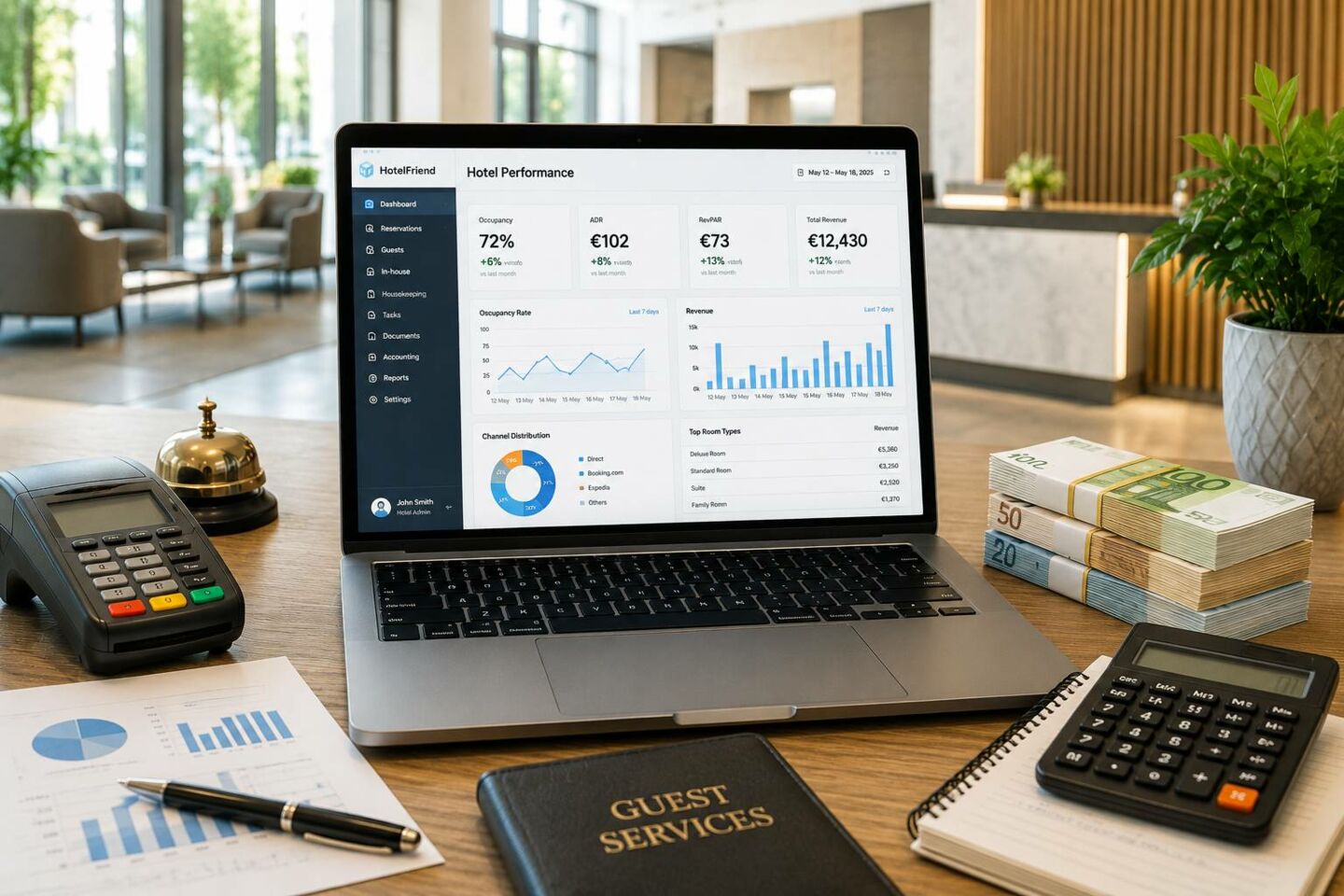
At 15 to 30 rooms, what matters isn't a dashboard built for hundreds of properties. It's clear visibility into occupancy trends, revenue by room type, and channel performance, without needing a data analyst to read it. The best small-hotel PMS platforms build this reporting into the core product instead of gating it behind a premium tier.
As booking volume grows, look for a system that also scales into:
- ● Demand forecasting
- ● API access for custom reporting integrations
That way the reporting a hotel starts with can keep pace as the property grows from 20 rooms to 40, without needing to be replaced.
Small Hotel Guest Feedback Software
The easiest way to collect guest feedback well is to not treat it as a separate tool. When requests trigger automatically from the same guest profile used for check-in and in-stay messaging, staff never have to remember to send them. A PMS with a built-in guest portal and messaging makes this possible, keeping a stay's history, communication, and feedback in one place instead of split across a booking system and a bolted-on survey app.
For a small hotel, that means:
- ● No second subscription
- ● No separate login
- ● No guest data getting lost between systems
Communication Software for Small Operations
For small operations juggling phone, email, SMS, WhatsApp, and OTA inboxes all at once, the real question isn't whether a tool sends messages. It's whether that messaging is native to the PMS or another app competing for attention. A PMS with native messaging automatically pulls guest names, room numbers, and stay details into the conversation, so nobody has to copy information between systems during a busy check-in.
That's the difference between:
- ● Guest communication as a built-in part of daily operations
- ● Guest communication as one more subscription and one more inbox to check
HotelFriend Experience
We tested the rollout of digital in-room menus and QR-code service ordering across our partner hotels. The result: average spend on additional services (room service, spa, rentals) increased by 27%, since guests find it psychologically easier to place an order from a smartphone screen than to call the front desk.
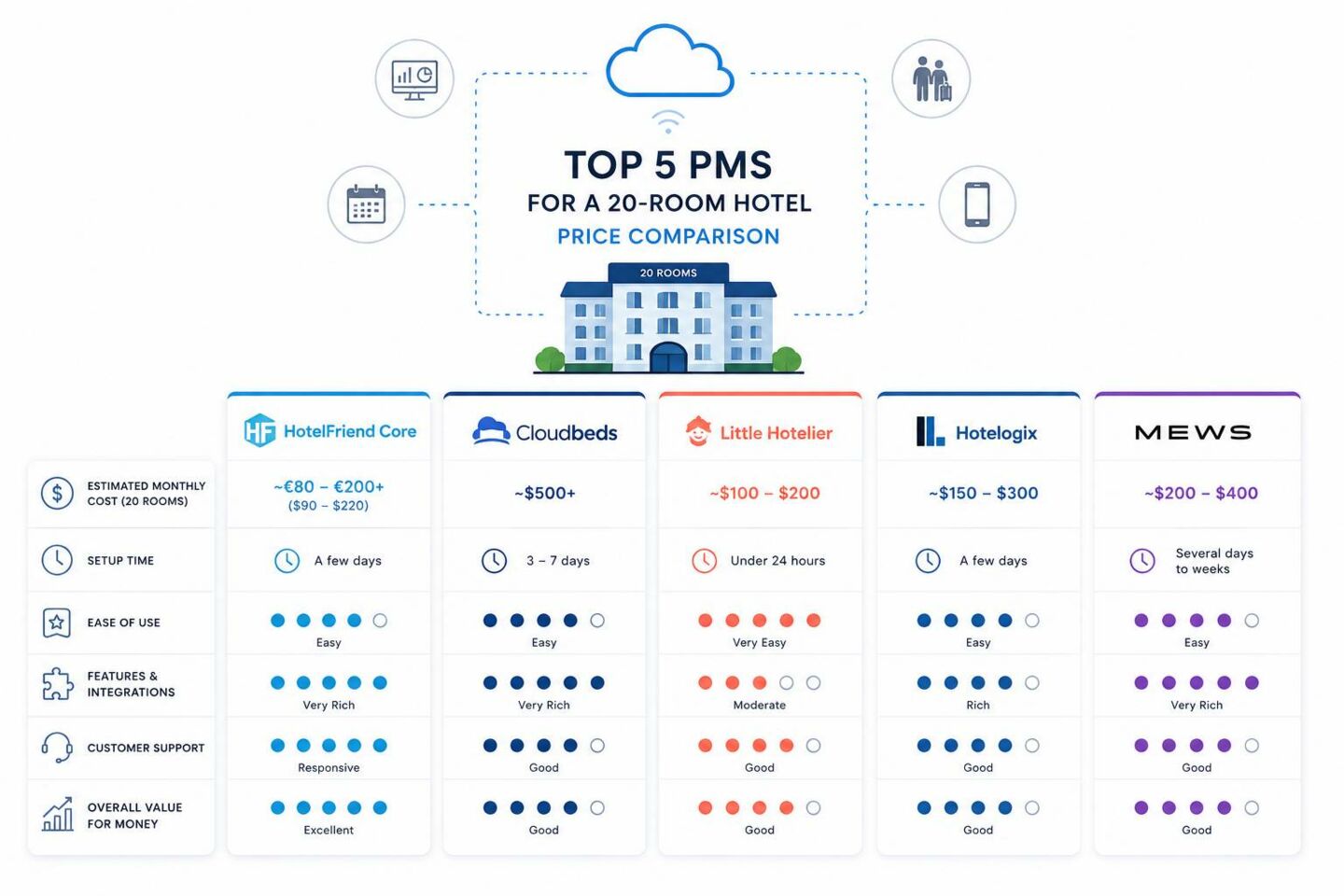
Top 5 PMS for a 20-Room Hotel - Price Comparison
A 20-room property sits in an interesting spot: big enough to need real channel management and reporting, small enough that enterprise pricing doesn't make sense. Here's how five well-known options for this size range typically stack up on cost, setup time, and core strengths.
Feature & Price Matrix
Costs and setup times vary widely even among platforms built for the same property size, so it helps to see them side by side before narrowing down a shortlist.
Table: 20-Room Hotel PMS Comparison at a Glance
|
PMS |
Approx. Monthly Cost (20 rooms) |
Setup Time |
Best Known For |
|
HotelFriend Core |
~€80–€200+ (roughly $90–$220) |
A few days |
Ready-to-use PMS bundling booking, channel management, housekeeping, and invoicing in one package |
|
Cloudbeds |
~$500+ |
3–7 days |
All-in-one platform with a large distribution network |
|
Little Hotelier |
~$100–$200 |
Under 24 hours |
Simplicity for very small, owner-run properties |
|
Hotelogix |
~$150–$300 |
A few days |
Strong reviews for value and support |
|
Mews |
~$200–$400 |
Several days to weeks |
Design-forward interface with a large app marketplace |
Use-Case Recommendations
The right pick usually comes down to what matters most for your specific property, not which platform has the longest feature list. Here's how these five options tend to fit different priorities:
- ● Choose HotelFriend Core if you want a ready-to-use system that bundles reservations, channel management, guest communication, housekeeping, and invoicing without piecing modules together yourself.
- ● Choose Cloudbeds if you want a single vendor that covers PMS, channel manager, and booking engine, and your budget supports a higher monthly cost.
- ● Choose Little Hotelier if you're owner-operated with minimal staff and want to be live within a day.
- ● Choose Hotelogix if support quality and proven reliability matter more than flashy extras.
- ● Choose Mews if brand presentation and a design-led guest experience are central to your property's identity.
Buying Recommendations for Small Hotels with 20 Rooms
Choosing a PMS at this size isn't about finding the "best" system in the abstract. It's about matching a platform to your specific operation, budget, and growth plans. A structured approach saves you from picking based solely on a slick demo.
Decision Framework

Before requesting quotes, it helps to rank what actually matters for your property:
- ● Budget ceiling, including setup and per-transaction fees, not just the monthly rate
- ● Growth plans, so the system handles 30–40 rooms without a painful migration
- ● Distribution needs across OTAs and direct channels
- ● Guest experience priorities like online check-in or digital keys
- ● Integration needs with existing accounting or POS tools
Once these are ranked, shortlist two or three vendors that clear your top priorities, then request a live demo and, where possible, a trial period long enough to test a real week of operations rather than a guided walkthrough.
Implementation Tips
A good PMS choice can still go poorly if the rollout is rushed. A few habits make the switch smoother:
- ● Migrate historical data early, since cleanup always takes longer than expected
- ● Run old and new systems in parallel briefly, if the vendor allows it
- ● Train staff only on their daily tasks, not the full feature set
- ● Go live outside peak season
- ● Confirm what support looks like in the first 30 days
- ● Revisit the setup after a month to drop unused modules or adjust settings